Growth Marketing
Electrician Marketing Plan for Australia: A Practical 90-Day Guide to More Qualified Enquiries
21 September 2026

An electrician marketing plan should use the first 90 days to strengthen trust, capture useful job details and improve enquiry handling before increasing promotional spending. Start by choosing the electrical work you want, checking available capacity and establishing a baseline. Then build visibility around the services your team can deliver.
The problem is not always too few enquiries. An electrical business might receive urgent fault calls outside its operating hours, domestic upgrade requests outside its service area and commercial invitations that lack enough detail to quote. Our electrical marketing services in Australia focus on connecting promotion with the practical work of attracting, assessing and following up suitable enquiries.
This guide divides that work into three phases: foundations in days 1–30, demand capture in days 31–60 and enquiry quality improvements in days 61–90. Treat the schedule as an operating plan, adjusting the pace to your workload and resources.
1. Start your electrician marketing plan with the work you want
Your electrician marketing plan needs a clear definition of desirable work before you choose channels or create campaigns. “More electrical jobs” is too broad to guide service pages, advertising or office priorities.
Choose priority services and customers
Choose services according to your actual offering, commercial priorities and ability to respond. A team seeking recurring commercial maintenance needs different messages and enquiry handling from one filling gaps with domestic lighting work.
Use this table to set your starting priorities:
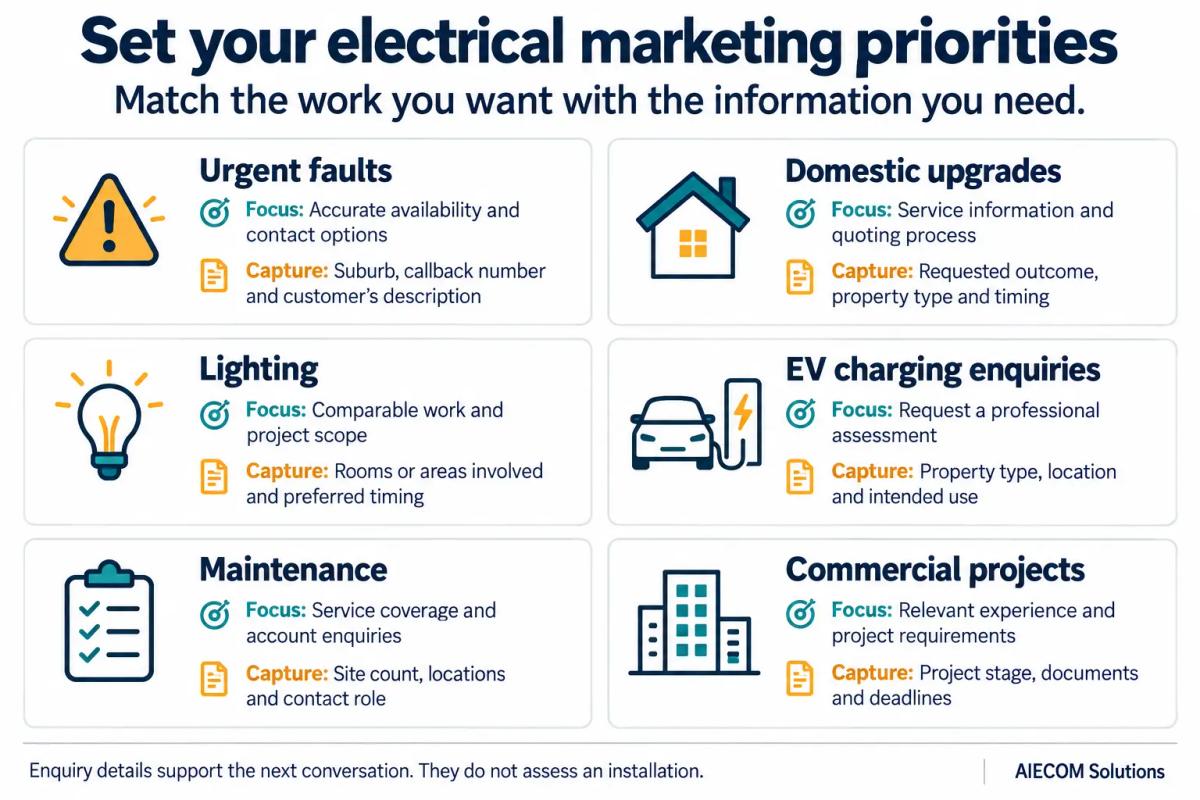
Select a small set of priorities for the first cycle. You can still accept other suitable work without giving every service equal marketing attention.
Define a qualified enquiry
A qualified enquiry is one that matches your service offering, coverage and current commercial criteria closely enough to justify the next conversation. It is not a confirmed booking or proof that the proposed work is technically suitable.
Write a short definition the owner and office team can apply consistently. For example: the request concerns an offered service, sits within the operating area, includes usable contact details and has a timeframe the business can discuss.
Keep technical assessment separate from marketing qualification. A website form cannot determine whether an installation is suitable or what electrical work is required.
2. Check capacity and establish a useful baseline
Your starting baseline should show what enquiries arrive, how the team handles them and where suitable opportunities stop progressing. This gives you something concrete to compare against at the end of 90 days.
Review capacity before generating demand
Capacity includes the time needed to answer enquiries, assess scope, arrange appointments, prepare quotes and deliver work. A gap in the installation calendar does not automatically mean the office can handle another campaign.
Before promotion begins, agree on:
- Which services you can actively promote.
- Which locations fit your scheduling and travel arrangements.
- Who handles calls and website enquiries.
- Who prepares domestic and commercial quotes.
- What happens when the usual enquiry owner is unavailable.
- When promotion should be reduced because capacity is tight.
Advertise only the availability you actually provide. If urgent enquiries are accepted during limited hours, make those hours clear.
Record the full enquiry journey
A simple shared spreadsheet can establish the baseline if everyone uses it consistently. The important part is recording outcomes, rather than collecting a large volume of disconnected activity data.
Include enquiry date, source, requested service, suburb, first human response time, qualification status, next action, quote status and won or lost outcome. Add a reason where an enquiry is unsuitable or a quote does not proceed.
Define terms before reporting. For example, decide whether “won” means a booking accepted or another agreed business milestone, and distinguish a human response from an automatic acknowledgement.
Set targets after reviewing the starting position
Targets should reflect your baseline, capacity and commercial priorities. Without that context, a target for more enquiries may encourage spending that creates extra administration without useful work.
Start with operational commitments: record every enquiry, assign every suitable request and give every open quote a next action. Add numerical performance targets once the starting data is reliable enough to support them.
3. Days 1–30: Fix service pages, trust and scope capture
The first month should make it easier for suitable customers to understand your offering and for your team to handle their enquiries. Complete these foundations before expanding paid promotion.
Build priority service pages around real decisions
Each priority page should explain the service offered, the customers it suits, your operating area and what happens after an enquiry. Use the questions your office already answers to decide what belongs on the page.
A lighting page might address how customers can describe the rooms and changes they have in mind. A commercial maintenance page might explain how facilities teams can submit site details and discuss their requirements.
A useful page structure includes:
- The service and customer need.
- Relevant work examples, where available and approved.
- The information needed to begin a conversation.
- Your actual enquiry and quoting process.
- Clear contact options and operating hours.
If the website makes these details difficult to find, prioritise website design and branding for electrical businesses before adding more traffic.
Make credibility specific and verifiable
Credibility signals should help a prospective customer understand who the business is and what experience supports its offering. Use genuine team information, approved project photographs and accurate descriptions of completed work.
Check every claim about qualifications, licences, insurance, memberships and experience before publication. Check your state or territory requirements, and have a licensed electrician review technical, safety and compliance wording.
Avoid broad statements such as “experts in everything electrical”. A precise description of the work you actually undertake gives customers more useful information.
Capture enough scope for the next conversation
The enquiry form should collect enough information to route the request without expecting the customer to diagnose an electrical issue. Keep the initial form short, with additional fields only where they help a particular job type.
Useful fields include:
- Name and preferred contact details.
- Suburb and property type.
- Requested service.
- A plain-language description of the request.
- Preferred timing.
- Optional project documents where relevant.
For EV charging enquiries, collect the customer’s intended use and basic property details for a subsequent conversation. Do not suggest that form answers establish installation suitability, electrical capacity or compliance.
Review the free electrical website tools for resources relevant to your enquiry process. Verify each tool’s purpose before using it, and never present a website tool or calculator as an assessment of an installation.
Test enquiry handling from start to finish
Every contact route should be tested through to the person responsible for responding. Submit a test form, check the confirmation, verify delivery and confirm that the enquiry appears in your chosen record.
Repeat the check on mobile, including telephone links and any document upload fields. Make sure the acknowledgement accurately describes what happens next without implying that an appointment has been booked.
By day 30, a suitable customer should be able to understand your offering, contact you and reach a named owner without unnecessary friction.
4. Days 31–60: Capture demand through selected channels
The second month should bring relevant visitors to the foundations you have built. Choose channels according to the work you want and your ability to manage the resulting enquiries.
Strengthen local visibility around genuine coverage
Local visibility starts with accurate business information and useful service content. Review your business listings, website contact details, operating hours and stated coverage for consistency.
Describe service coverage in terms that customers can use, including any genuine differences between domestic and commercial work. Avoid creating near-identical pages whose only meaningful difference is a suburb name.
For reviews, use a consistent process to invite honest feedback after completed work. Follow the platform’s current rules and avoid requests that depend on the customer giving a positive rating.
Use Google Ads selectively
A selective advertising campaign is easier to evaluate when it promotes a defined service in an area the business can support. Begin with a scope that your team can monitor and a spending limit you are prepared to review.
Match the advertisement to its destination. A campaign about commercial maintenance should lead to information for commercial customers, rather than a generic page dominated by domestic call-outs.
Review available search enquiry information, customer locations and actual lead outcomes. Where the account supports it, refine settings and exclusions to reduce clearly irrelevant demand, checking the current platform options before implementation.
Do not assess advertising only by clicks or submitted forms. Compare the enquiries with your qualification definition and check whether suitable requests progress.
Publish content that helps customers enquire
Decision-stage content should help prospective customers prepare for a useful conversation. Start with questions that repeatedly delay your office team or lead to incomplete enquiries.
Practical electrician marketing ideas include:
- What information to include in a lighting project enquiry.
- How to brief an electrician about a planned domestic upgrade.
- What documents to gather for a commercial project discussion.
- How property managers can submit maintenance requests consistently.
- What to expect from your business’s EV charging enquiry process.
Keep content about wiring, switchboards, EV charger installation, safety or compliance within your editorial review process. Have a licensed electrician check those statements before publication.
Where execution needs coordination, SEO, paid ads and content marketing support can be scoped around the priorities and measurement process established in the first month.
5. Days 61–90: Improve enquiry quality and quote progression
The third month should identify which activity produces suitable opportunities and where those opportunities lose momentum. The goal is a better electrical lead generation process, with decisions based on outcomes rather than volume alone.
Compare sources by suitability and progression
Compare each source using qualified enquiries, quoting progress and recorded outcomes. A source that generates many contacts may also create substantial work filtering requests your business cannot accept.
Use a short monthly scorecard:
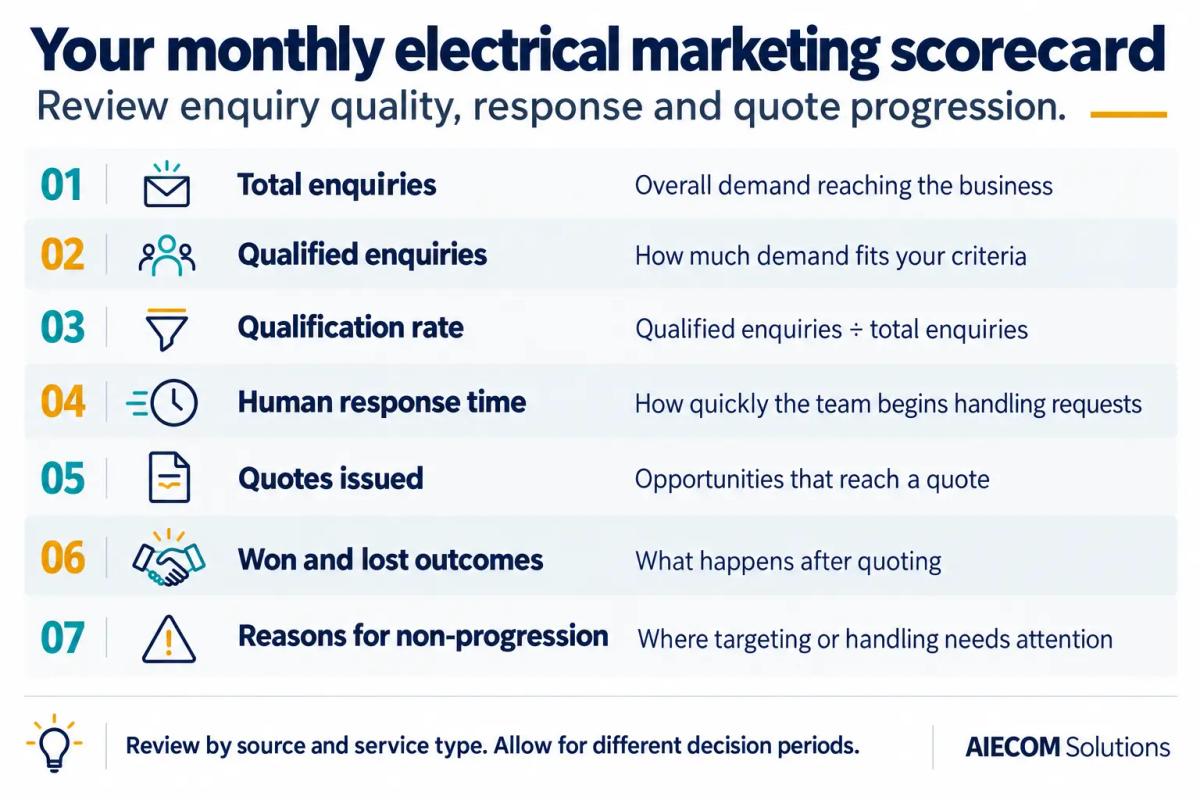
Review service type alongside source. Domestic lighting enquiries and commercial project invitations may have different decision periods, so avoid treating unfinished commercial opportunities as immediate failures.
Give every open quote a next action
Quote follow-up should establish the customer’s position and make the next step clear. Assign an owner and a follow-up date appropriate to the job and the conversation already held.
A domestic customer may need to clarify scope or timing. A builder may be waiting on revised documentation, while a facilities contact may need approval from another decision-maker.
Use lead capture and automated follow-up to support acknowledgements, routing and reminders where appropriate. Verify the proposed system’s capabilities and stop follow-up when an enquiry is closed or the customer asks not to continue.
Turn findings into a monthly operating cycle
A monthly review should end with a small set of changes, each with an owner and a reason. Review capacity, enquiry quality, quote progression and channel spending together.
For example, repeated out-of-area lighting enquiries may justify clearer coverage information. Commercial requests that stall because documents are missing may justify revising the project form.
Record what changed and when. This helps distinguish a useful improvement from a temporary fluctuation.
6. Adapt the plan to different electrical work types
Your electrical contractor marketing strategy should reflect how customers choose and organise different kinds of work. Keep shared reporting standards, but adapt page content, contact routes and follow-up to the job.
Urgent call-outs need accurate availability
Urgent call-out marketing should make actual operating hours, coverage and contact options easy to find. Only promote emergency or after-hours availability if the business genuinely provides it.
Give urgent enquiries an agreed internal route when staff are available to handle them. Do not imply that an online submission guarantees an immediate response or provides electrical-safety guidance.
Domestic upgrades need clear scope and expectations
Domestic upgrade enquiries benefit from a clear explanation of how your business moves from an initial request to the appropriate next discussion. Customers planning lighting changes or other upgrades may not know which details matter.
Ask about the intended outcome, relevant areas of the property and preferred timing. Keep switchboard, wiring and installation statements subject to licensed-electrician review, and avoid presenting initial customer descriptions as a complete technical scope.
Commercial and maintenance work need structured handovers
Commercial enquiries need enough context to reach the right person and establish the next action. Capture the organisation, contact role, site locations, project stage and relevant deadlines.
Keep recurring maintenance opportunities distinct from one-off project quotes. Record whether the next step is a scope discussion, document review or another agreed action, rather than leaving the enquiry under a vague “pending” status.
7. Common mistakes that weaken the plan
The most common mistakes disconnect promotion from the business’s actual offering, capacity or enquiry process. Check for them before deciding that a channel needs more spending.
Promoting every service equally
Equal promotion can dilute attention when some services matter more to the business than others. Choose priorities for the current cycle and ensure the website and campaigns reflect those choices.
Treating every contact as a useful lead
Raw enquiry counts can hide unsuitable locations, services you do not offer and requests you cannot schedule. Report qualified demand separately and keep the reasons for disqualification visible.
Publishing technical shortcuts as helpful content
Marketing content should not turn into remote diagnosis or installation advice. Keep articles focused on service selection, enquiry preparation and your business process, with licensed-electrician review wherever technical statements appear.
Expanding demand while follow-up is inconsistent
Additional demand increases the number of enquiries needing attention. Before expanding promotion, check that existing suitable requests receive a human response and that open quotes have a recorded next action.
Changing too much at once
Simultaneous changes make it harder to understand what influenced enquiry quality. Prioritise a manageable set of improvements, record implementation dates and allow for the decision periods of the work being promoted.
8. What good looks like after 90 days
A useful 90-day outcome is a clearer, more accountable path from customer interest to a suitable next conversation. It does not require every channel to grow or every quote to be accepted.
By the end of the period, your team should be able to explain:
- Which electrical services are the current priorities.
- Whether promotion matches available capacity.
- How customers find the business.
- Which sources produce suitable enquiries.
- Who owns each open opportunity.
- Why quotes progress, stall or close.
- Which improvement comes next.
The website should explain the offering accurately, and the enquiry process should capture useful context without making technical judgements. Monthly reviews should connect marketing activity with the work the business actually wants.
Ready to see where your electrical lead flow is breaking down? Request an electrical growth audit with AIECOM Solutions.
9. Frequently asked questions
These answers summarise the main decisions involved in implementing the plan.
What should an electrician do first in a 90-day marketing plan?
Start by choosing priority services, checking capacity and defining a qualified enquiry. Then review service pages, contact options and the way enquiries reach the team. Record a baseline before expanding promotion so you can compare enquiry suitability, response times and quote progression. This makes the first month useful even before additional channel activity begins.
How much should an electrical business spend on marketing?
Set spending according to available resources, delivery capacity and the services you want to promote. Establish a limit for initial activity and review the suitability of the resulting enquiries before expanding it. There is no single budget appropriate for every electrical business. Separate website improvements, ongoing channel work and advertising spend so each cost has a clear purpose.
Should electricians prioritise local SEO or Google Ads?
The priority depends on your website, current visibility, target services and capacity to manage campaigns. Accurate local information and useful service pages provide a foundation for either approach. A limited advertising campaign may be worth testing once enquiry handling and measurement work reliably. Assess the combination using qualified opportunities and outcomes, rather than assuming one channel suits every business.
Can an online form or calculator qualify electrical work?
An online form can organise an enquiry by collecting contact details, location, requested service and timing. It cannot assess an installation, determine electrical capacity or establish technical suitability or compliance. Keep marketing qualification separate from professional assessment, and have a licensed electrician review wording about wiring, switchboards, EV charger installation, safety or compliance. Check your state or territory requirements.
NEXT STEP
Ready to Work With a Team That Actually Delivers?
Book a free strategy call. No pitch. Just honest advice.