Design, Development & Branding
What Should an Electrician's Website Show Before a Customer Requests a Quote?
22 September 2026

The most useful electrician website trust signals show customers that the business understands their job, has relevant experience and offers a clear next step. Service information, genuine project evidence, verified credentials and a straightforward enquiry process should be visible before someone has to ask.
The problem is often missing detail. A homeowner cannot tell whether you handle domestic lighting upgrades, a facilities manager cannot find maintenance information, or a builder sees finished photographs without any explanation of your role. Our electrical marketing services in Australia focus on helping electrical businesses communicate their work and organise the enquiries that follow.
Your website should help visitors answer three questions: “Do they do this work?”, “What evidence can I check?” and “What happens if I contact them?”
1. Put five electrician website trust signals where customers need them
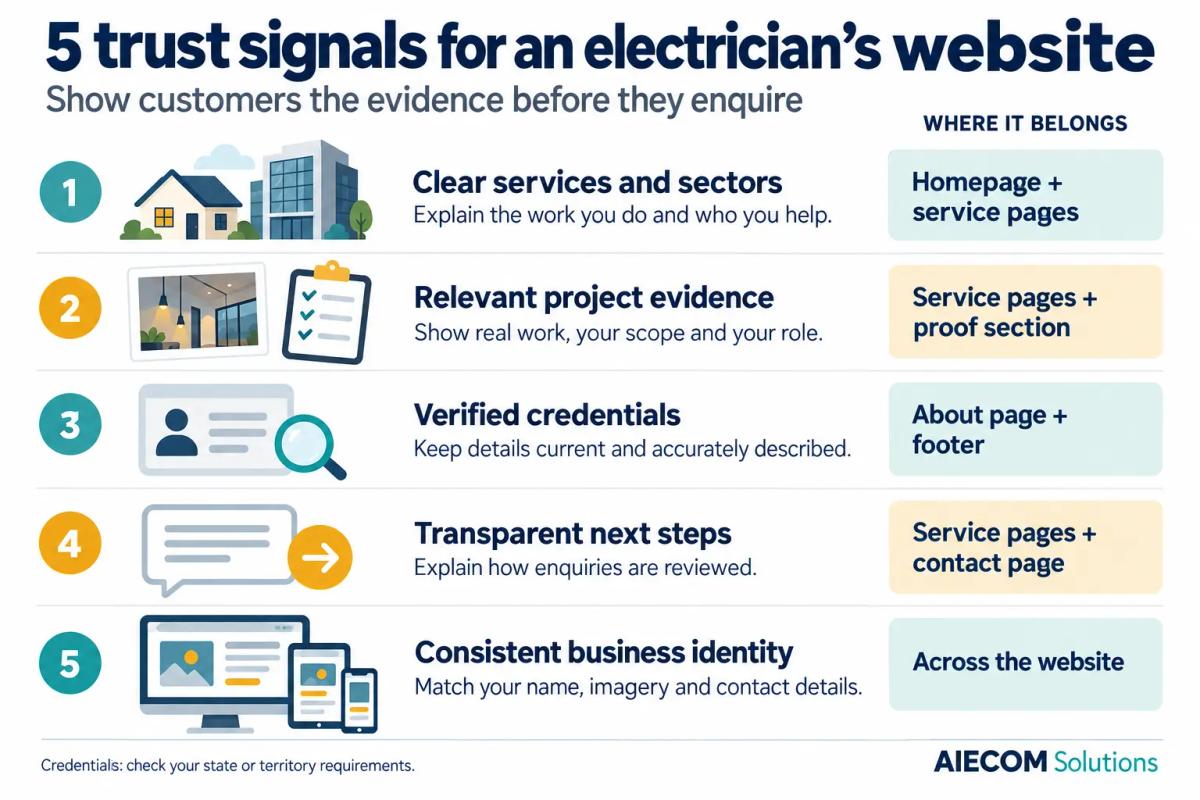
Five trust signals give visitors a practical basis for deciding whether to enquire: clear services, relevant project evidence, verified credentials, transparent next steps and a consistent business identity.
Each signal should appear near the decision it supports. Someone reading about commercial maintenance should find relevant evidence on that page, without having to search a general gallery.
Make the homepage a useful starting point
The homepage should explain the business quickly and direct visitors towards the information relevant to their job.
Name the services and sectors you genuinely support. If you undertake domestic upgrades, commercial maintenance and selected project work, give each a clear route rather than presenting one long, undifferentiated service list.
Keep a short proof section near this overview. A real team photograph, a relevant project summary and accurate business details provide more context than a headline such as “Your trusted electrical experts” on its own.
2. Explain which electrical work you undertake
Clear service information helps customers recognise whether their enquiry fits your business before they spend time contacting you.
An electrical contractor website should distinguish between different types of work. Urgent fault enquiries, planned lighting changes, EV charging enquiries and commercial projects involve different customer questions and booking expectations.
Separate the service from the customer's situation
A useful service page explains both the work offered and the circumstances in which customers typically enquire.
For lighting, describe whether your business handles homeowner enquiries, commercial premises or lighting packages within larger projects. For maintenance, explain which types of organisations you work with and how they can start a conversation.
Cover the practical basics:
- The service and customer types you accept.
- Your actual service area.
- Relevant examples of completed work.
- Information useful for an initial enquiry.
- What happens after submission.
Avoid expanding into services simply to attract search traffic. A page should represent work the business currently accepts.
Make urgent and planned enquiry routes clear
Urgent fault enquiries need clear contact expectations, while planned work needs enough detail to start a useful discussion.
Display your actual operating hours and accurately describe any after-hours availability. If a form is reviewed only during office hours, say so beside the form rather than leaving customers to infer that it is monitored continuously.
For planned work, invite a short description and preferred timing. Keep the website focused on collecting an enquiry; a form or calculator cannot assess an installation.
3. Show project evidence with enough context
Project evidence becomes useful when it explains what your business contributed, rather than relying on photographs to tell the whole story.
A finished office, retail tenancy or residential renovation can involve several contractors. State your actual scope so visitors can understand which work belongs to your business.
Use a repeatable case-study framework
A short case study should connect the customer's brief with your documented role and the completed scope.
Use the same framework for each example:
- Customer and setting: Identify the property or organisation type, with permission.
- Brief: Explain what the customer asked the business to deliver.
- Scope: Describe the work your team undertook.
- Coordination: Explain relevant access, scheduling or communication arrangements.
- Evidence: Include approved photographs and records supporting the description.
- Outcome: State only what you can substantiate.
A commercial lighting example might explain the agreed work area and how visits were coordinated with the customer's operations. Any claim about reduced disruption, energy use or cost needs evidence before publication.
Match evidence to the enquiry you want
Relevant examples help customers judge your experience with work resembling their own.
A domestic customer considering a lighting upgrade needs different context from a facilities manager seeking maintenance support. A builder may need to understand your contribution to a wider project and how your team communicated with the other parties.
Use genuine photographs with explanatory captions. Obtain permission, remove sensitive information and avoid presenting stock imagery as completed work.
If you lack permission to identify a customer, consider an approved, anonymised project summary. Do not invent details to make it appear more substantial.
4. Present credentials accurately and transparently
Credentials should be current, verifiable and clearly connected to the business or person they describe.
For what must appear on your website, check your state or territory requirements. Have a licensed electrician review credential wording and any statements about wiring, switchboards, EV charger installation, safety or compliance before publication.
Give credentials context
An electrician credentials website section should explain what each credential represents instead of displaying unexplained badges.
Where applicable and verified, this may include the relevant name, credential type, number and issuing organisation. Check the accuracy of membership descriptions and whether you have permission to use associated logos.
Avoid language that turns a narrow credential into a broad claim. A membership, course or manufacturer relationship should not be presented as proof of capabilities beyond its actual scope.
Keep business details consistent
Consistent business details make it easier for customers to understand who they are contacting.
Check the business name, public contact details, service area and operating hours across the homepage, footer and contact page. Explain any relationship between a trading name and another business name where needed.
Publish insurance or experience claims only when you can substantiate their wording. Assign someone to review credentials and other time-sensitive details so an accurate launch does not become an outdated website.
5. Show what happens after a customer enquires
A transparent enquiry process tells customers what information to provide and what response they can reasonably expect.
“Request a quote” can mean several things. Explain whether your team first reviews the enquiry, calls to clarify the scope, arranges a visit or requests project documents.
Describe the actual process
Your published enquiry steps should reflect how the office and field team work in practice.
For example, if accurate for your business:
- The customer submits their contact details and a brief description.
- The office reviews the enquiry during stated hours.
- The team contacts the customer to clarify the request.
- The appropriate next step is discussed.
Do not imply that every submission produces an immediate quote or confirmed booking. Publish response-time commitments only when your team can support them.
Ask for enough information to start
A short initial form should collect information useful for the first conversation.
Typical fields might include name, contact details, suburb, service required and a short description. Commercial and project customers may also need an optional field for their organisation or project timing.
Only offer document uploads if you have a working process for receiving and reviewing them. Make clear that submitting information does not assess the installation or confirm a booking.
6. Match the evidence to domestic, commercial and project customers
Different customer groups need different evidence because they organise and purchase electrical work in different ways.
You do not need three separate websites. Clear page sections or service routes can give each audience the information it needs.
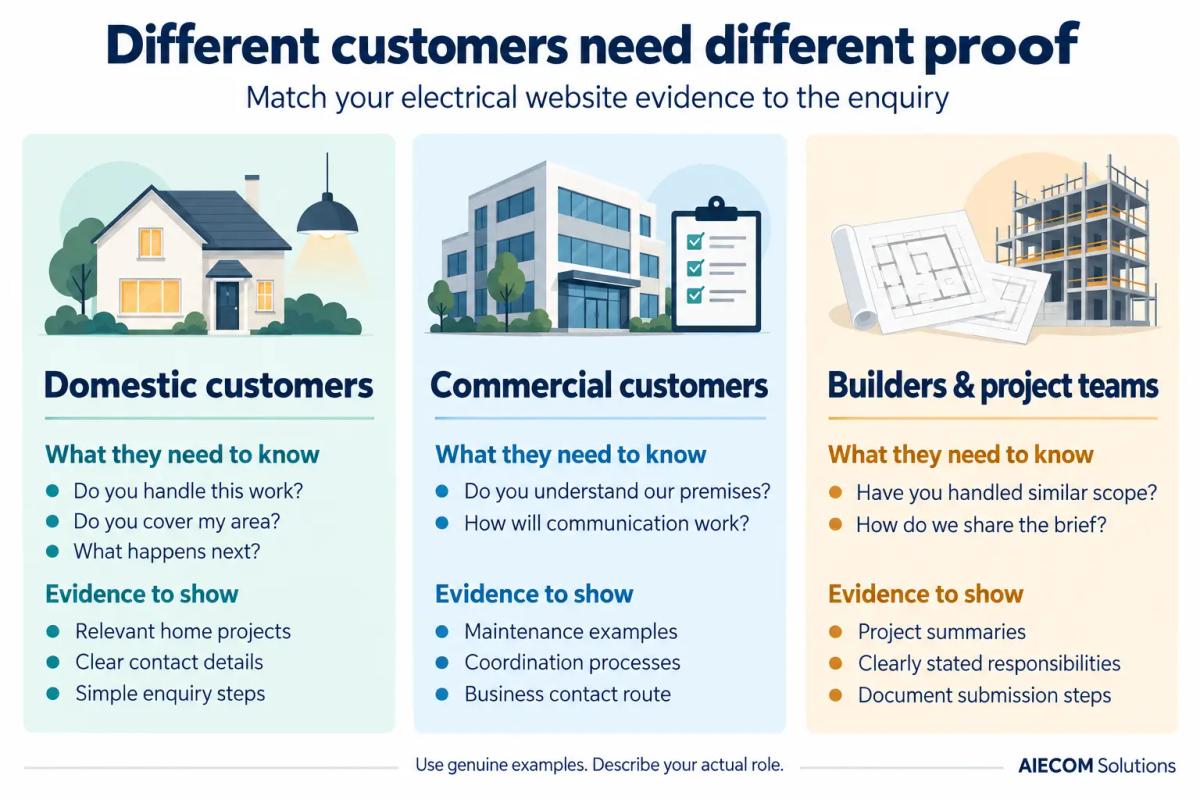
Have you undertaken comparable scope, and how do we discuss the brief?
Project summaries, clearly stated responsibilities and document submission instructions
Give homeowners practical detail
Homeowners need plain descriptions that let them recognise their request without knowing technical terminology.
For domestic upgrades or EV charging enquiries, explain what information helps start a conversation and how the business follows up. Have a licensed electrician review any installation-related content, and avoid suggesting that website answers determine suitability.
Help business customers assess organisational fit
Commercial and project customers need evidence of how your business communicates and coordinates its work.
Describe your actual arrangements for enquiries, scheduling discussions and project contacts. If your business offers particular reporting or handover documents, name them only after confirming what customers receive.
Be specific about your role in past projects. Do not imply responsibility for a complete fit-out when your involvement covered one defined package.
7. Make the website professional and usable on mobile
Professional electrician website design should make important information easy to find, read and act on.
Consistency matters across typography, photographs, page layouts and contact details. Website design and branding for electrical businesses should bring those elements together around real customer decisions.
Test the complete mobile enquiry journey
A mobile visitor should be able to find the relevant service, inspect evidence and contact the business without avoidable friction.
Check the journey on actual phones:
- Is the business name readable?
- Can visitors find services and operating hours?
- Do phone buttons dial the correct number?
- Are project captions legible?
- Can someone complete the form comfortably?
- Are errors explained clearly?
- Does submission show a useful confirmation?
Keep contact buttons from covering page content. Compress large photographs and check that essential information remains usable while images load.
Use a recognisable business identity
A consistent identity helps visitors connect the website with the business they encounter elsewhere.
Use genuine team and vehicle photography where appropriate, with permission. Keep the business name, logo and tone consistent across pages.
Remove template leftovers, broken pages and unrelated stock images. These details deserve attention because they can create uncertainty at the point someone is deciding whether to contact you.
8. Connect trust signals to your marketing channels
Marketing channels should take visitors to pages that support the specific service or promise that attracted them.
Someone responding to commercial maintenance content should arrive at relevant maintenance information. A visitor researching domestic lighting should find examples and next steps suited to that work.
Align the message and destination
Your advertisements, search content and destination pages should describe the same offer accurately.
SEO, paid ads and content marketing support works best as a coordinated activity with clear page responsibilities. Before promoting a service, check its page for scope, evidence, credentials and contact expectations.
Use an electrician marketing plan for Australia to organise those improvements alongside your broader marketing priorities.
Review enquiry quality as well as volume
Enquiry quality helps reveal whether the website is setting accurate expectations.
Ask the office to record recurring problems: requests outside your service area, work you do not undertake or misunderstandings about availability. Review these patterns alongside submitted forms and customer feedback.
Treat the findings as clues. A change in enquiries does not, by itself, prove that one website edit caused the difference.
9. Avoid common mistakes that weaken trust
Common website mistakes leave customers uncertain about your experience, availability or the next step.
Check for these issues:
- Unverifiable superlatives: “Australia's best” without defensible evidence.
- Unsupported guarantees: Promises about results, availability or turnaround that the business cannot substantiate.
- Unexplained galleries: Photographs without a description of your work.
- Generic service pages: Different headings sitting above essentially identical content.
- Unclear hours: Forms that appear to offer immediate attention when they do not.
- Outdated credentials: Details that nobody is responsible for checking.
- Excessive forms: Requests for extensive information before an initial conversation.
- Technical overreach: Content suggesting a form or calculator can assess an installation.
- Unverified testimonials: Customer comments with no confirmed source or publication permission.
Correct misleading or inaccurate information first. Then prioritise missing evidence and friction in the enquiry journey.
10. What good looks like before the quote request
A good electrical business website helps visitors understand your fit, inspect relevant evidence and know what contacting you will involve.
A homeowner can find the right domestic service and a useful example. A facilities manager can understand your maintenance offering, while a builder can identify comparable project scope and a route for discussing documents.
The website should also help your office start better-informed conversations. Review whether customers understand your services, operating hours and enquiry process, then use recurring questions to improve the relevant pages.
Ready to see where your electrical lead flow is breaking down? request an electrical growth audit with AIECOM Solutions.
11. Frequently asked questions
These answers summarise the main decisions involved in presenting an electrical business clearly before a customer requests a quote.
What should an electrician website include?
An electrician website should include clear services, customer sectors, service areas, genuine project evidence, verified credentials and straightforward contact instructions. Explain operating hours and what follows an enquiry. Put relevant evidence on service pages as well as any gallery or About page. Check your state or territory requirements for credential information, and have a licensed electrician review technical statements before publication.
Where should an electrician display credentials on a website?
Display verified credentials where customers can find and understand them, such as the About page, relevant service pages and footer. The appropriate information depends on the business and your state or territory requirements. Explain what each credential represents, keep details current and avoid implying broader capabilities than it supports. Have a licensed electrician review the wording before it goes live.
Can a new electrical business build website trust without testimonials?
A new electrical business can build trust through clear service descriptions, genuine team information, verified credentials and an honest enquiry process. Add project evidence as suitable work is completed and publication permission is obtained. Describe previous individual experience accurately, distinguishing it from work delivered by the new business. Never invent testimonials or present another employer's projects as your own company's work.
Should domestic and commercial electrical services have separate pages?
Separate pages are useful when the services, customer questions and supporting evidence differ substantially. Domestic visitors may need a simple explanation of the enquiry process, while commercial customers may need maintenance examples and coordination details. Create separate pages when you can provide meaningful, distinct information. Avoid duplicating the same text with a changed heading simply to create more search pages.
NEXT STEP
Ready to Work With a Team That Actually Delivers?
Book a free strategy call. No pitch. Just honest advice.