Automation & Systems
Breakdown vs Planned HVAC Enquiries: How to Design Lead Paths That Fit the Work
23 September 2026

Breakdown vs planned HVAC enquiries need different contact paths because customers arrive with different priorities. Someone whose ducted air conditioning has stopped working wants to know whether you cover their suburb and can respond; someone planning a replacement needs help defining the scope, assessing your experience and arranging a quote.
Design five journeys around those differences: breakdowns, replacements, new installations, maintenance agreements and commercial work. Each needs appropriate questions, a clear response expectation, an assigned owner and follow-up that matches the decision being made.
For businesses reviewing their HVAC marketing services in Australia, this means connecting website content with office processes. A useful enquiry path helps the customer take the next step and gives your team enough information to handle it.
1. How breakdown vs planned HVAC enquiries differ
The main differences are customer mindset, information needed, response expectations and the next decision. Urgent HVAC enquiries need a short route to a person who can confirm availability, while planned enquiries need a route towards a properly scoped conversation.
Use the following comparison as a working page blueprint.
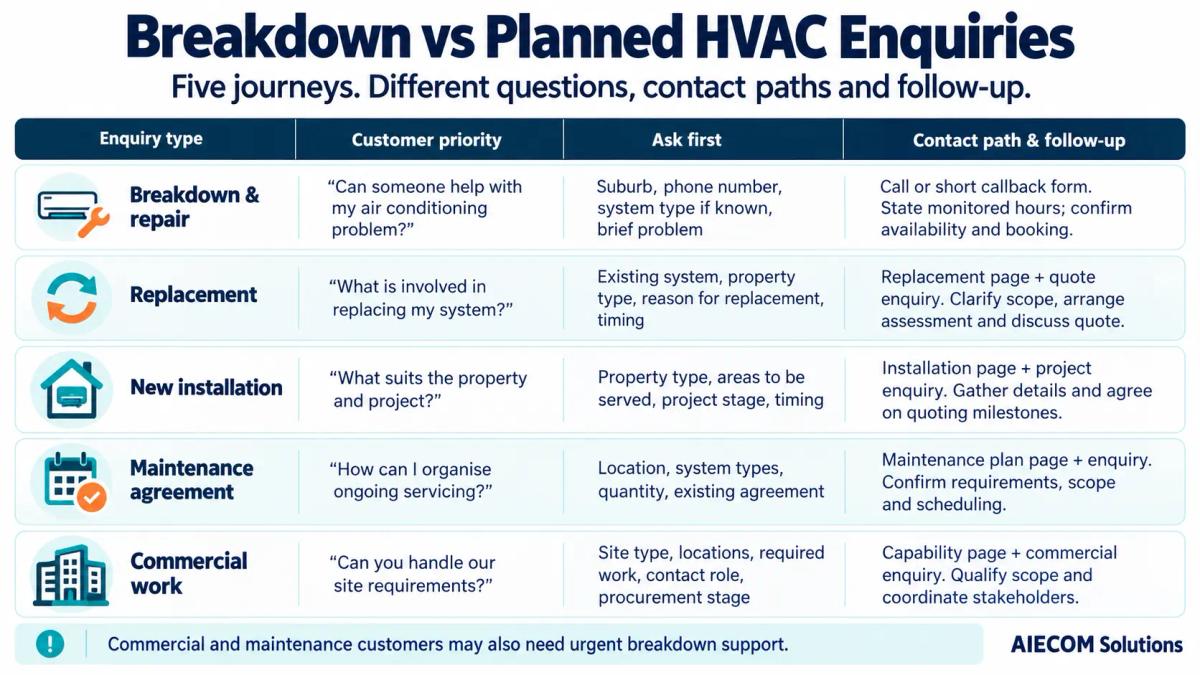
Treat urgency and customer type as separate details
Commercial and maintenance customers can also have urgent breakdowns, so the five journeys should not become rigid boxes. A facility manager reporting a failed system needs a breakdown response, with their commercial account details carried into the handover.
Similarly, a repair enquiry may later become a replacement discussion. Keep the original enquiry history when the work changes direction.
2. Design the breakdown path around a useful first response
The breakdown path should make it easy to establish contact, confirm coverage and explain what happens next. Its purpose is to support an availability conversation, not collect a complete technical history.
Make calling easy and offer a short form
Click-to-call should be prominent on mobile breakdown pages wherever calling is a supported contact option. Label the action clearly, and offer a callback form for customers who cannot speak immediately.
Start with:
- Name and contact number.
- Suburb or postcode.
- A short description of the problem.
- System type, with an “unsure” option.
Only require email if your process needs it at this stage. Avoid making model numbers, installation dates or photographs mandatory before someone can ask for help.
Check the service area before collecting a full enquiry
A service-area check should tell customers whether their location is covered without implying that an appointment is available. Coverage and current capacity are separate questions.
Place the service-area check tool alongside the relevant coverage information, and confirm that its output suits the way you handle enquiries. If coverage needs manual review, explain that the office must confirm it.
Use suburb information to route the enquiry internally. Avoid sending customers through a long list of location pages just to discover whether you attend their address.
Explain after-hours handling accurately
After-hours wording should state when enquiries are monitored and when customers can expect a response. A submitted form or automated acknowledgement must not look like confirmation of attendance.
Distinguish between receiving an enquiry, reviewing it and booking a visit. Only advertise after-hours attendance or specific response windows when the business can support those statements.
Before seasonal peaks, review these messages alongside the HVAC summer peak preparation checklist. Update website expectations when office coverage or appointment capacity changes.
3. Give planned enquiries a clear route towards a decision
Planned paths should help customers understand your work, provide useful scope information and agree on the next step. They can collect more detail than a breakdown form, but each question should serve the quoting or qualification process.
Replacement enquiries need existing-system context
A replacement path should establish what the customer has now and what they want to change. Useful prompts include whether they are replacing a split system or ducted system, which areas they want served and their preferred timing.
Support the page with verified examples of comparable work and an explanation of your assessment process. Avoid asking customers to choose a technical solution before the relevant assessment.
Offer photographs as an optional follow-up where useful. The initial enquiry should still work for someone who does not know their equipment details.
Installation enquiries need project-stage questions
A new installation path should identify the property, intended scope and stage of the project. An owner adding air conditioning to an existing home needs different follow-up from a builder coordinating a new build.
Ask whether the project involves an existing property, renovation or new construction. Then collect the areas to be served, approximate timing and whether plans are available.
Explain who reviews the enquiry and what they may request next. Provide a practical way to share plans without making large uploads compulsory on the first form.
Maintenance enquiries need a defined plan page
A maintenance plan page should explain the proposed service scope, how scheduling is arranged and what customers need to discuss before an agreement is prepared. Publish only inclusions and service arrangements the business actually offers.
Ask about location, system types, approximate system quantity and existing maintenance arrangements. A homeowner with two split systems and a property manager coordinating several properties should receive different follow-up questions.
Keep requests for one-off servicing distinguishable from interest in an ongoing agreement. Neither should automatically be treated as an agreement sale.
Commercial enquiries need relevant capability evidence
A commercial capability page should help the enquirer judge whether your experience fits their site and procurement process. Use verified project descriptions, relevant team experience and an explanation of how commercial enquiries are assessed.
Collect site type, location, required work, project stage and the contact’s role. Where relevant, ask about tender deadlines or documentation requirements without assuming every commercial enquiry is a formal tender.
Include an urgent breakdown option for existing and prospective commercial customers. Do not make them complete a project questionnaire to report a current fault.
4. Set HVAC lead routing rules and assign ownership
HVAC lead routing should direct each enquiry to someone who can take the next action, using service, location and customer type. Every route also needs a backup when the usual owner is unavailable.
Route by service, suburb and customer relationship
Start routing with the requested work, then check coverage and any existing customer relationship. A simple sequence is:
- Identify breakdown, replacement, installation, maintenance or commercial requirements.
- Check the suburb against the relevant service area.
- Identify homeowner, tenant, property manager, builder or facility contact.
- Check for an existing account, agreement or open enquiry.
- Assign an owner and record the next action.
Include an “unsure” route for ambiguous enquiries. Customers should not need to understand your internal departments to reach the right person.
Give every path an owner and a backup
Ownership means responsibility for progressing the enquiry, not simply receiving an email notification. The assigned person should know what to do next and when to escalate an unanswered task.
For example, a business might assign breakdowns to its service coordinator, planned installation quotes to an estimator and maintenance enquiries to its service manager. These are suggested roles; one person may cover several in a smaller organisation.
When a breakdown becomes a replacement opportunity, record the handover explicitly. Keep the customer’s original information and explain who will contact them next.
Automate acknowledgements without overstating progress
Automated follow-up should confirm receipt, explain the next step and help the assigned person keep track of unfinished work. It should not imply that an appointment or quote is confirmed before someone has arranged it.
A practical lead capture and automated follow-up process can be designed around acknowledgements, assigned tasks and reminders. Confirm what your actual systems support before specifying how information will move between them.
Stop or change reminders when an appointment is booked, a quote is declined or the customer no longer needs help. Repeated generic messages are especially unhelpful after someone has already spoken with the office.
5. Measure each enquiry path against its next useful outcome
Each path should be measured against the decision it supports, rather than a single total enquiry count. Separate response performance, qualification, quoting and completed outcomes.
Measure breakdowns by contact and booking progress
Breakdown reporting should show whether customers received a useful response and whether suitable work progressed to a booking. Track time to first human response separately from automated acknowledgements.
Useful measures include:
- Missed calls and completed callbacks.
- Time to first human response during stated monitored hours.
- Enquiries inside the service area.
- Suitable enquiries that become booked visits.
- Unbooked enquiries and the recorded reason.
Keep receipt, response and appointment timestamps separate. A quick acknowledgement does not establish whether someone was helped.
Measure planned work by quote progression and decisions
Planned enquiry reporting should show where suitable opportunities stop moving. Track time to first contact, assessment arrangements, quote preparation, follow-up and the final decision.
For quote-to-win reporting, define the denominator consistently. One approach is accepted quotes divided by quotes with a recorded won or lost decision, while open quotes remain visible separately.
Assess maintenance and commercial work against their own milestones, such as a scope review, site meeting or procurement decision. Compare similar enquiry types before drawing conclusions about performance.
6. Avoid common mistakes in HVAC contact paths
The common mistakes are collecting inappropriate information, setting unclear expectations and leaving enquiries without accountable owners. Review the customer-facing journey and the office workflow together.
One generic form for every service
A generic form becomes a problem when it asks everyone the same questions and sends every submission into an undifferentiated inbox. Begin with a clear service choice and show only the relevant fields.
A shared form can still work if its questions, confirmation message and internal routing adapt to the selected enquiry type.
Long forms on urgent pages
Long breakdown forms add unnecessary work when the immediate task is confirming contact details, coverage and availability. Move non-essential technical questions into the follow-up conversation.
Test the form on a phone, including the “unsure” answers. Customers should be able to submit an enquiry without knowing whether their system description is technically precise.
No owner for planned quotes
Planned quotes need a named owner, a next action and a review date. Otherwise, a replacement enquiry can remain untouched while the team concentrates on current call-outs.
Review outstanding quotes separately from the breakdown queue. Record whether each quote needs clarification, a customer decision or an internal action.
7. What good HVAC enquiry paths look like
Good air conditioning website contact paths make the next step clear to both the customer and the team. Customers understand how to enquire and what to expect; staff can see who owns the enquiry and what needs to happen.
Test each journey from page visit through to internal handover. Submit a breakdown callback, a replacement enquiry, an installation project, a maintenance request and a commercial enquiry.
Check that each test reaches the correct person, carries the submitted details and produces an accurate acknowledgement. Repeat the check for an out-of-area address, an after-hours submission and an enquiry that changes from repair to replacement.
Ready to see where your HVAC lead flow is breaking down? request an HVAC growth audit with AIECOM Solutions.
8. Frequently asked questions
These answers explain how to apply separate enquiry journeys without making the website or office process unnecessarily complicated.
Should breakdown and installation enquiries share one form?
Breakdown and installation enquiries can share one underlying form if the questions and routing change with the selected service. Keep the breakdown branch short and use the installation branch to collect project scope and timing. Separate forms may be easier to manage when different teams handle the work. In either case, tailor the confirmation message and assign an owner.
How quickly should urgent HVAC enquiries receive a response?
Urgent HVAC enquiries should receive a response within a timeframe the business can realistically support and clearly communicate. Distinguish monitored hours from after-hours submissions, and measure the first human response separately from automatic receipt messages. Do not publish a universal response promise without checking staffing and capacity. Acknowledging an enquiry also does not mean an appointment has been confirmed.
What should an HVAC repair vs installation enquiry form ask?
An HVAC repair vs installation enquiry form should begin with the requested service and location, then show relevant questions. Repair enquiries need contact details and a brief problem description, with system type optional if unknown. Installation enquiries can ask about property type, project stage, areas to be served and timing. Request further technical information during follow-up when it helps define the scope.
Do separate enquiry paths require different software systems?
Separate enquiry paths do not necessarily require different software systems. The essential requirements are recognisable enquiry types, useful information, assigned ownership and visible next actions. Depending on your existing setup, these may be managed within one system. Check its actual capabilities before planning conditional forms, automatic assignments or reminders, and test the full handover before relying on it.
NEXT STEP
Ready to Work With a Team That Actually Delivers?
Book a free strategy call. No pitch. Just honest advice.