Automation & Systems
Urgent Treatment, Inspection or Ongoing Plan? How to Design Enquiry Paths for a Pest Control Business
20 October 2026

Good pest control enquiry paths send each type of customer down a route built for what they actually need. A homeowner who wants something dealt with today, a buyer booking an inspection, a family considering an ongoing plan and a facilities manager after a commercial contract are all asking different questions. If they all land on the same generic contact form, some of them will leave before they ever speak to you.
The fix is not more forms or more pages. It is a clear set of paths, each matched to the customer’s mindset, the information your team needs, a realistic response time and the right follow-up. This is a core part of how we approach pest control marketing services in Australia, because traffic only matters if enquiries reach the right person quickly.
This guide walks through each path, how to route enquiries once they arrive, what to measure, and the mistakes that most often cost pest control businesses good jobs.
1. Why pest control enquiry paths need to differ
Pest control enquiry paths need to differ because each enquiry type comes with a different level of urgency, a different decision process and different information requirements. Treating them the same slows down urgent jobs and overwhelms planned ones with questions they are not ready to answer.
The four main paths compared
The table below summarises how the four most common paths differ. Use it as a starting point and adjust the wording to match your own services and service area.
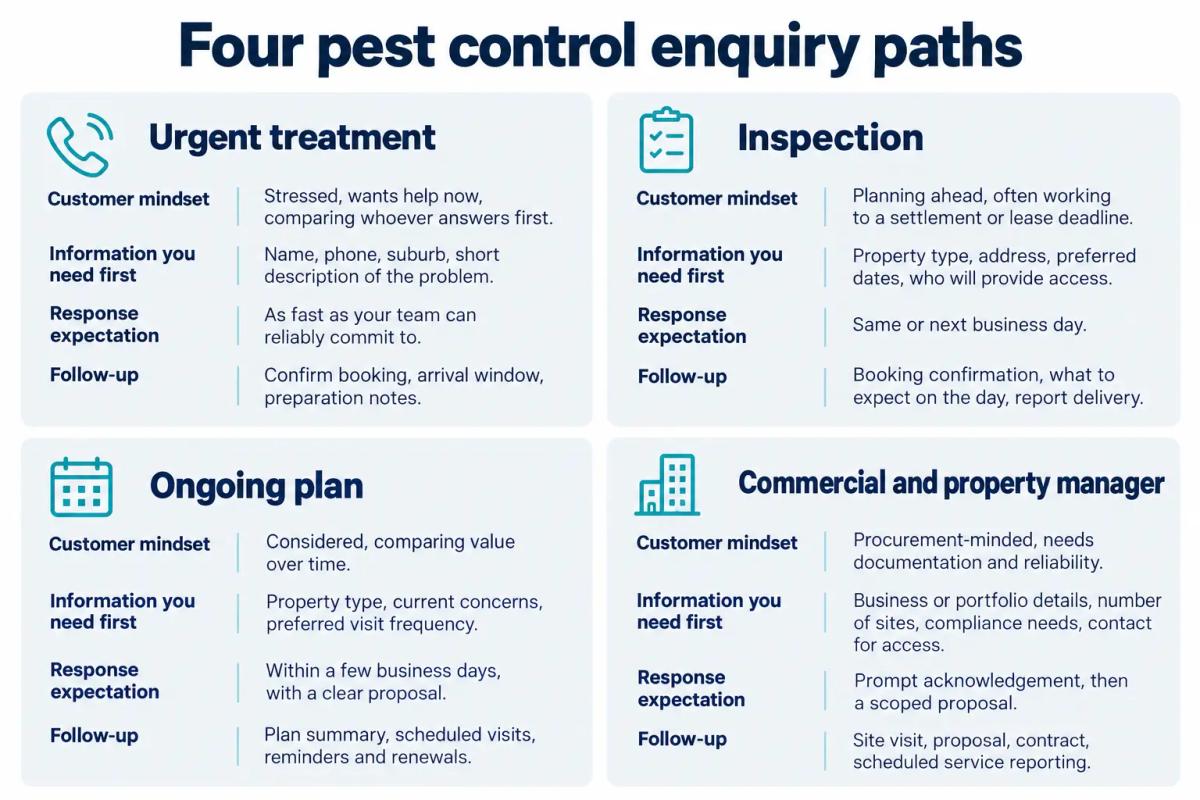
2. Designing the urgent treatment path
The urgent path should make it as easy as possible to reach a person quickly and confirm you service the area. Everything else is secondary.
Lead with reassurance, not alarm
The first thing an urgent visitor should see is calm confirmation that you can help and how to reach you. Avoid graphic imagery or fear-based headlines; a stressed customer wants clarity, not more worry.
A short line such as “Need help today? Call us or send a quick request and we’ll confirm availability” does more than a paragraph of sales copy.
Click-to-call first, short form second
Click-to-call should be the most prominent action on mobile for urgent enquiries. Many people in this situation would rather talk than type.
For those who cannot call, offer a short form with only the essentials:
- Name and phone number
- Suburb or postcode
- A brief description in the customer’s own words
- Preferred contact time
Do not ask the customer to identify the pest or assess the problem themselves; that is your technician’s job. For a deeper look at field choices, see what to put on a pest control enquiry form.
Check the service area early
A service-area check stops out-of-area enquiries from wasting both your time and the customer’s. Placing it at the top of the urgent path also builds confidence for customers who are in your area.
A simple postcode lookup works well here. Our service-area check tool shows one way to set this up so customers get an instant answer.
3. Designing the inspection path
The inspection path should explain the process clearly and make booking straightforward. Inspection customers are usually planning ahead and want certainty about timing and what they will receive.
Explain what happens on the day
Customers book with more confidence when they know what to expect. Describe your own process in plain language:
- How the booking is confirmed
- Who needs to be present or provide access
- Roughly how long you allow on site, based on your typical jobs
- How and when the report is delivered
Keep this factual and based on how your business actually works. Requirements for inspections and reports vary, so check your state or territory requirements before describing scope or standards on the page.
Make booking simple
The booking step should ask for the details your scheduler needs and nothing more. Property type, address, preferred dates and an access contact usually cover it.
If the inspection is linked to a deadline, such as a property settlement, give customers a field to note it. That one detail helps your team prioritise without a back-and-forth phone call.
4. Designing the ongoing-plan path
The ongoing-plan path should help customers understand value over time and make it easy to say yes. These customers are comparing options, so clarity beats urgency.
Show what is included
A clear summary of what each plan covers reduces hesitation. List the inclusions in plain terms, note what sits outside the plan, and explain how additional call-outs are handled.
Avoid vague promises. If something depends on the property or the technician’s assessment, say so.
Let your business set the frequency options
Frequency options should reflect what your business actually offers and recommends, not what a template suggests. Present them as simple choices, such as a small set of named plans, rather than an open-ended field.
This makes quoting faster and keeps expectations consistent across your team.
Build reminders into the follow-up
Reminders are where ongoing plans are kept or lost. Confirm upcoming visits in advance, send a short note after each service, and flag renewals before they lapse.
Seasonal changes are a natural trigger for these messages. Our pest control seasonal preparation checklist covers how to plan communications and capacity around busy periods.
5. Designing the commercial and property-manager path
The commercial and property-manager path should look professional, capture scope early and signal reliability. These buyers often answer to someone else and need documentation they can pass on.
Commercial and food premises
Commercial enquiries need enough detail to scope the job without feeling like a tender document. Useful fields include business type, number of sites, approximate size, preferred service windows and a site contact.
Food premises and other regulated sites may have specific compliance needs. Rather than describing those requirements yourself, ask the customer what their obligations are and note that they should check their state or territory requirements. Your team then follows up with a tailored proposal.
Property managers and strata
Property managers and strata managers usually need repeatable processes across many properties. Give them a path that recognises this:
- A field for the number of properties or lots
- Separate contacts for the manager and the person providing access
- A note on how reports and invoices should be sent
- An option to discuss an ongoing arrangement rather than a one-off job
A dedicated landing page for this audience often performs better than burying it inside a general contact page.
6. Routing rules and owners
Routing rules decide where each enquiry goes the moment it arrives. Without them, urgent jobs sit in a shared inbox next to commercial proposals and newsletter sign-ups.
Keep the rules simple
Start with a small set of rules based on the path the customer chose and their location:
- Urgent enquiries go straight to whoever handles same-day bookings, with an instant alert.
- Inspection requests go to the scheduler with the deadline field visible.
- Ongoing-plan enquiries go to the person who prepares plan quotes.
- Commercial and property-manager enquiries go to the account or sales lead.
- Out-of-area enquiries receive a polite automated reply.
Setting this up with lead capture and automated follow-up means each enquiry is tagged, assigned and acknowledged without anyone sorting it by hand.
Assign an owner to every path
Every path needs a named person responsible for it, plus a backup. Routing only works if someone is accountable for the response.
Review ownership before busy periods so cover is in place when enquiry volume rises.
7. What to measure on each path
Each path should be measured on its own, because a single conversion rate hides where problems really are. Track a few simple numbers per path:
- Urgent: time to first response, calls answered versus missed, bookings from enquiries
- Inspection: time to booking confirmation, reports delivered on time
- Ongoing plan: proposals sent, plans accepted, renewals retained
- Commercial and property manager: proposals sent, site visits booked, contracts won
Where you need benchmarks, compare each path against its own past performance rather than industry averages, starting from whatever records you have today and building from there. These numbers also feed into your wide pest control marketing plan for Australia, showing which channels bring the enquiries you actually want.
8. Common mistakes
The most common mistakes come from treating every enquiry as the same. Watch for these:
- One form for everything. Urgent customers abandon long forms, while commercial buyers find short ones unprofessional.
- Hiding the phone number. On mobile, urgent visitors should never have to scroll to find it.
- Asking customers to diagnose the problem. Let them describe it in their own words and leave identification to your technicians.
- Collecting unnecessary personal details. Do not ask about health conditions on forms; if a customer raises something sensitive, handle it by phone in line with your privacy policy.
- No service-area check. Out-of-area enquiries clog the queue and frustrate customers.
- No owner for each path. Shared responsibility often means no one responds.
- Forgetting follow-up on plans. Missed reminders lead to lapsed plans that were easy to keep.
9. What good looks like
A well-designed set of pest control enquiry paths feels simple to the customer and organised to your team. Each visitor quickly sees the option that matches their situation and knows what happens next.
In practice, that means:
- Urgent visitors can call or send a short request in seconds and get a fast reply.
- Inspection customers understand the process and can book around their deadline.
- Ongoing-plan customers see clear inclusions and receive timely reminders.
- Commercial clients and property managers get a professional path and a scoped proposal.
- Every enquiry is routed to a named owner and measured by path.
Ready to see where your pest control lead flow is breaking down? Request a pest control growth audit with AIECOM Solutions.
Frequently asked questions
What are pest control enquiry paths?
Pest control enquiry paths are separate routes on your website and phone system for different types of customers, such as urgent treatments, inspections, ongoing plans and commercial contracts. Each path asks for the information that type of job needs, sets a realistic response expectation and triggers the right follow-up, so customers are not forced through a single generic contact form that suits nobody.
How many questions should an urgent pest control enquiry form have?
An urgent pest control enquiry form should be as short as possible, usually covering name, phone number, suburb or postcode and a brief description in the customer’s own words. Anything else can be gathered on the phone. Click-to-call should sit above the form on mobile, because many urgent customers prefer to speak to someone straight away rather than type out details.
Should commercial pest control enquiries use a separate form?
Yes, commercial and property-manager enquiries usually work better with their own form or landing page. These buyers need to share scope details such as the number of sites, service windows and access contacts. A dedicated path looks more professional, helps your team prepare an accurate proposal, and keeps commercial leads from getting lost among residential requests in a shared inbox.
How do I know which enquiry path is underperforming?
Measure each path separately rather than relying on one overall conversion rate. Track time to first response, enquiries that become bookings or proposals, and follow-up outcomes such as renewals for ongoing plans. Comparing these numbers by path quickly shows where customers drop off, whether that is missed calls on urgent jobs or slow proposals for commercial work.
NEXT STEP
Ready to Work With a Team That Actually Delivers?
Book a free strategy call. No pitch. Just honest advice.