Automation & Systems
Electrical Quote Follow-Up: A Practical Cadence for Larger Jobs
19 October 2026

Electrical quote follow-up works best as a short sequence with a named owner, a useful reason for each contact and a clear stop condition. For larger jobs, the aim is to help the customer make a decision not keep sending “just checking in” until someone replies.
A quote for a lighting upgrade, EV charging project or commercial maintenance agreement can involve questions about scope, access, budgets and approval. As part of our electrical marketing services in Australia , we help businesses think through how enquiries move towards a clear next step, including what happens after a quote goes out.
This guide sets out a suggested cadence, practical message templates and a simple tracking structure. Treat the timing as a starting point: an agreed customer deadline or project milestone should always take priority.
1. Why larger electrical quotes stall
Larger electrical quotes can stall because the customer has unresolved questions or needs another person’s approval. Silence alone does not explain whether the job is delayed, lost or still being considered.
Repeated reminders will not resolve a scope question that nobody has identified. Start by understanding what the customer needs to decide.
Scope needs clarification
Scope questions can hold up a decision when the customer cannot clearly compare what is included, excluded or optional.
For a domestic lighting project, the customer might be deciding which rooms to include or whether to supply their own fittings. For commercial work, they may need to understand which areas, visits or project stages the quote covers.
Ask which part needs clarification. Any technical explanation or change to the proposed electrical work should go back to the electrician responsible for the quote.
Timing and approval are unresolved
Timing and approval can keep a genuine opportunity open even when the customer is comfortable with the proposal.
A homeowner may be coordinating an electrical upgrade with a kitchen renovation. A facilities contact might be waiting for budget approval, while a builder may need the wider project programme confirmed.
These differences matter when handling domestic vs commercial electrical enquiries . Record the decision process rather than assigning every quote the same reminder schedule.
The customer is comparing suppliers
Supplier comparisons can delay a response while the customer works through differences between proposals.
Offer to clarify your own scope, assumptions and exclusions. Avoid guessing what another contractor has allowed for or immediately offering a discount.
A useful question is: “Is there anything in our scope that you need us to explain before you decide?”
2. A practical electrical quote follow-up cadence
A practical electrical quote follow-up cadence gives each contact a purpose, an owner and a condition that stops the sequence.
The schedule below is an illustrative starting point for larger, non-urgent jobs. Count from the date the quote is issued, use business days and replace the suggested dates with any timing agreed with the customer.
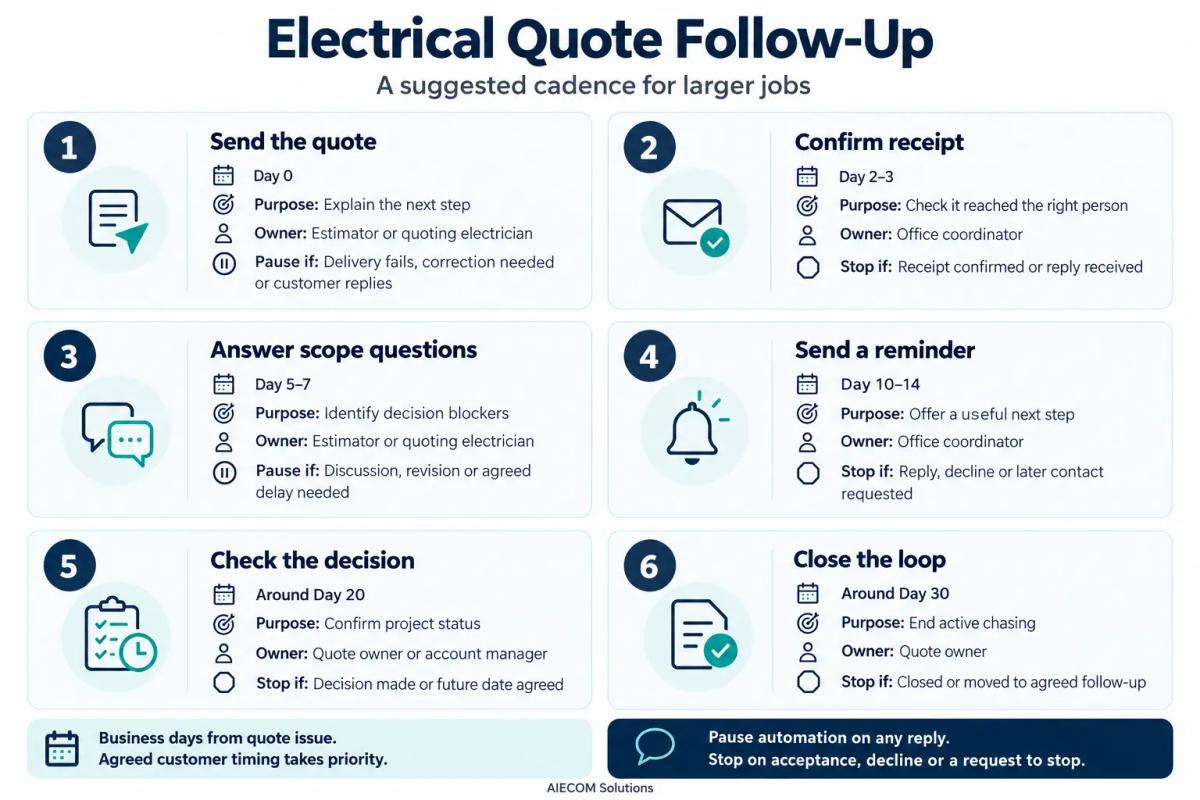
Acceptance, a decline, a request to stop or any substantive reply should interrupt the automated sequence immediately. Review the record before deciding what happens next.
Step 1: Acknowledge and send the quote
The first message should identify the work, provide the quote and make the next action obvious.
Include the quote reference, relevant site or project, and the person handling questions. State an expiry date only if the quote actually has one.
Example
Hi Natalie,
Attached is quote [reference] for the lighting work we discussed at [property/project]. It sets out the included areas and the options discussed.
If anything needs explaining, reply here and [name] will help. Would [date] suit for a brief follow-up?
Step 2: Confirm receipt
The receipt check should establish whether the customer received the document, without asking them to make an immediate decision.
Skip this step if they have already acknowledged it. An email open indicator should not be treated as confirmation that the quote has been reviewed.
Example
Hi Natalie,
Just confirming that quote [reference] reached you. There is no need to decide today—please let me know if you need another copy or would like us to send it to someone else involved in the decision.
Step 3: Answer scope questions
The scope follow-up should uncover the question that is preventing progress.
For an EV charging proposal, ask whether the customer needs the quoted scope or project arrangements explained. Do not use the follow-up message to make technical claims or assess the installation.
Example
Hi Alex,
Is there anything in the EV charging proposal you would like us to explain before you decide? If helpful, I can arrange a short call with [electrician’s name] to talk through the quoted scope and your questions.
Step 4: Send a useful reminder
The reminder should refer to the actual project and offer one manageable next step.
Avoid repeating the entire quote or adding artificial urgency. Mention availability only when someone has checked it and the information is relevant.
Example
Hi Morgan,
I’m following up on quote [reference] for the office lighting project. Has your team had a chance to review the proposed areas and project arrangements?
If there is a question holding things up, send it through and I’ll get it to the right person.
Step 5: Check the decision
The decision check should make it easy to say yes, no or later.
For a commercial maintenance proposal, the immediate outcome may be an approval date rather than an acceptance. Record that date and stop the general sequence.
Example
Hi Sam,
Is the maintenance proposal still being considered, waiting for approval or no longer required?
A brief update is enough. If there is a better date to contact you, let me know and I’ll update our records.
Step 6: Close the loop
The final contact should end active chasing without creating pressure or pretending the quote has expired.
Mark the opportunity as “closed no response” when appropriate, keeping that separate from an explicit rejection. If the customer returns later, the quote owner can review the proposal before progressing.
Example
Hi Sam,
I haven’t heard back, so I’ll close off our active follow-up on quote [reference] for now.
If the project comes back onto your schedule, you are welcome to reply here and we can review the quote with you.
3. Give every quote an owner and a next action
Every open quote should have one accountable owner, even when several people help with follow-up.
The office coordinator may send reminders, while an estimator answers questions and a project manager discusses timing. One person still needs to check that the opportunity does not sit indefinitely between those roles.
Keep the handover clear
A clear handover records what the customer needs, who will respond and when the response is due.
“Customer has questions” is too vague. “Customer wants the optional reception lighting separated from the main office scope; estimator to respond by Thursday” creates a usable task.
A basic process for lead capture and automated follow-up should carry the original enquiry details into the quote record, so the customer does not have to explain the job again.
Define the next action before leaving the record
The next action should describe a task that someone can complete.
Useful examples include:
- Estimator to explain the revised lighting scope.
- Office coordinator to confirm the facilities manager received the proposal.
- Account manager to contact the builder after the stated approval meeting.
- Quote owner to close the opportunity after the final unanswered message.
“Follow up later” is not enough. Give the task an owner and a date.
4. Automate reminders and keep judgement human
Quote follow-up automation is most useful for routine administration, while people should handle questions, changes and decisions.
The process should be defined before reminders are switched on. Otherwise, automation can repeat an unclear process faster.
Automate predictable administration
Predictable administration includes creating tasks, flagging overdue actions and preparing standard messages.
Depending on the capabilities of your chosen system, useful actions may include:
- Creating a follow-up task when a quote is sent.
- Alerting the owner when the next action is overdue.
- Preparing a reminder with the correct quote reference.
- Pausing scheduled messages when a reply is received.
- Flagging open quotes without an owner or next action.
Verify each capability before relying on it. If replies cannot reliably pause messages, use automation to create internal tasks rather than send unattended emails.
Keep changes and objections with a person
A person should review anything that changes the quote, customer relationship or proposed next step.
This includes revised scope, pricing questions, access arrangements and requests for technical explanations. Office staff can acknowledge these questions, but the responsible electrician should review technical responses.
A website form can collect project information and questions. It cannot assess an electrical installation.
Check the record before sending
A final record check helps prevent reminders being sent after a conversation has already resolved the matter.
Check for phone calls, text messages, revised quotes, acceptance and requests to pause. If the customer has asked for contact next month, that agreement takes priority over the original sequence.
5. Use a simple quote follow-up template
A useful template brings the quote, owner, decision status and next action into one place.
Copy the following fields into a spreadsheet or CRM. You can save the spreadsheet as an XLSX or CSV file for your team to use.
Template fields
The template should capture enough information to guide action without becoming a second estimating system.
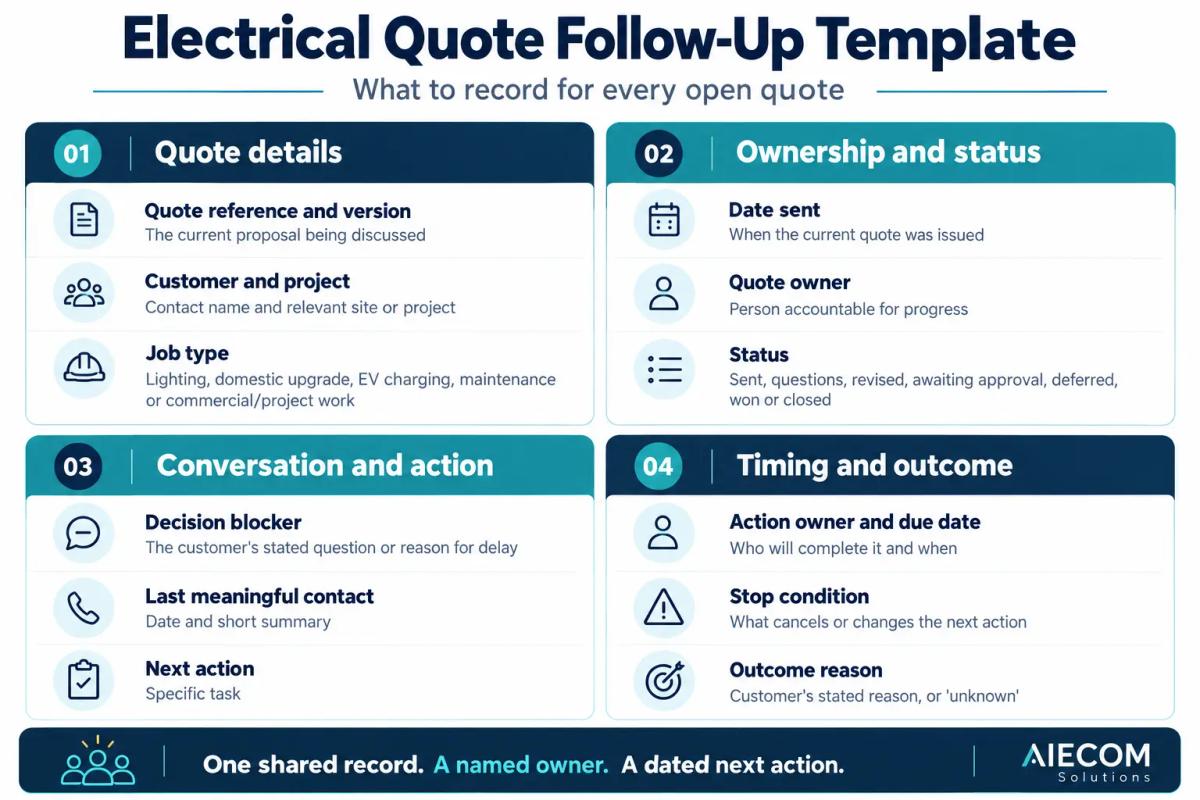
Use one agreed record as the source of truth. If the office works from a spreadsheet while estimators keep separate notes, decide how updates will reach everyone before starting the sequence.
Reusable reminder email
A reusable quote reminder email for an electrician should include project context and one clear question.
Subject: Quote [reference] — [project name]
Hi [first name],
I’m following up on our quote for [specific electrical work].
Is there anything you need clarified before deciding, or is the project waiting on timing or approval?
If you would prefer us to contact you on another date, let me know.
Thanks,
[name]
[business and contact details]
Change the message to reflect the last conversation. Do not send a timing question when the customer has already supplied the answer.
6. Track quote-to-win by job type
Quote-to-win tracking is more useful when you separate different kinds of electrical work and apply consistent definitions.
A domestic lighting quote and a commercial maintenance proposal may follow different decision processes. Combining them can hide where follow-up needs attention.
Define the calculation
A simple quote-to-win calculation divides accepted quotes by quotes issued within a defined group.
Quote-to-win rate = accepted quotes ÷ quotes issued × 100
Group quotes by issue date and job type, and show how many remain open. Recent groups may still be awaiting decisions, so do not compare them with older groups as though both are complete.
Count revised versions consistently to avoid treating one opportunity as several separate quotes.
Track the reason alongside the result
Outcome reasons help explain the numbers without guessing why a quote was lost.
Useful categories include accepted, project postponed, scope changed, another supplier selected and no response. Record budget as a reason only when the customer says it was a factor.
Also review missing next actions, unresolved questions and time to decision. These show where the process needs attention, even when quote-to-win has not yet changed.
7. Common mistakes in electrician quote follow-up
The most common mistakes make follow-up repetitive, poorly timed or disconnected from the customer’s actual decision.
- Sending the same generic nudge: Refer to the project and ask a useful question.
- Continuing after a reply: Pause the sequence and review the conversation.
- Having several people chase one quote: Assign one accountable owner.
- Discounting before understanding the issue: Find out whether the blocker is scope, timing, approval or price.
- Inventing urgency: Only mention genuine quote terms or verified scheduling information.
- Treating silence as a confirmed loss: Record “no response” separately from a decline.
- Using the larger-job sequence for urgent faults: Route urgent enquiries to a person for appropriate triage.
- Letting administrative messages answer technical questions: Refer those questions to the responsible electrician.
Review examples of actual follow-up each week. A short record review can reveal conflicting messages or unanswered questions that a dashboard does not explain.
8. What good looks like
Good electrical quote follow-up makes every open opportunity understandable without asking the whole team for an update.
Someone should be able to see what was quoted, what the customer is considering, who owns the next action and when active follow-up will stop.
The customer should receive relevant messages that respect their stated timing. Your team should spend less effort reconstructing conversations and more effort answering the questions that matter.
Start with one job type, use the cadence consistently and adjust it around recorded customer responses. The goal is a clear decision or an agreed next step—not the highest possible number of reminders.
Ready to see where your electrical lead flow is breaking down? Request an electrical growth audit with AIECOM Solutions.
9. Frequently asked questions
These answers explain how to adapt the suggested cadence to everyday quoting situations.
How often should an electrician follow up a larger quote?
Start with a receipt check after two or three business days, then space further contacts according to the project and customer’s response. The suggested cadence in this guide runs for around a month, but it is a working template, not a proven optimum. An agreed approval meeting or requested callback date should replace the default schedule.
What should a quote reminder email include?
Include the customer’s name, quote reference, specific project and one clear question. Ask whether they need clarification or whether timing and approval are holding up the decision. Keep the message short enough to answer easily. Avoid repeating the full proposal, inventing a deadline or sending a generic reminder that ignores the previous conversation.
Can electrical quote follow-up be fully automated?
Routine tasks and some messages can be automated where the system supports reliable status checks and stop conditions. Questions, objections, revised scope and technical explanations still need a person. Before enabling automatic sends, verify how replies, phone updates, accepted quotes and requests to pause affect the sequence. Use internal reminders if those controls are unreliable.
When should you stop trying to follow up electrical quotes?
Stop when the customer accepts, declines, asks you to stop or agrees to a different contact date. Pause when they reply with a question that needs attention. If there is no response after the planned sequence, close active follow-up and record the outcome as unknown or no response. Do not automatically add the customer to another sequence.
NEXT STEP
Ready to Work With a Team That Actually Delivers?
Book a free strategy call. No pitch. Just honest advice.