Automation & Systems
HVAC Quote Follow-Up: A Practical Cadence for Installation and Replacement Quotes
30 September 2026

Good HVAC quote follow-up is a short, owned sequence with a clear stop condition at every step. It should help customers make an installation or replacement decision by confirming receipt, answering questions and agreeing on what happens next.
A quote can stall because the customer needs to compare ducted options, discuss a split-system replacement with their partner or confirm a property owner’s approval. Repeated “just checking in” messages do little to resolve those questions.
For businesses reviewing their HVAC marketing services in Australia, follow-up deserves attention alongside enquiry generation. Start with the practical cadence below, then adjust it to the customer’s timing, the quoted work and your team’s capacity.
1. Find out why the HVAC quote has stalled
The most useful follow-up addresses the customer’s unresolved decision, rather than simply reminding them that a quote exists.
Separate missing information from a later decision
A customer who needs clarification requires a different response from someone waiting until their renovation reaches the installation stage.
For example, a homeowner comparing ducted replacement quotes might need help understanding the proposed scope. A builder might already understand the quote but need to confirm the construction programme.
Record the actual blocker where the customer provides one:
- Unclear inclusions or exclusions.
- Questions about the proposed system or installation scope.
- A preferred installation period that is still some time away.
- Approval from a partner, property owner or facilities manager.
- A request to compare replacement and repair options.
- A decision to postpone the project.
If the reason is unknown, record “awaiting response”. Silence alone does not establish that your price was too high.
Keep urgent replacements separate from planned installations
An urgent replacement following a breakdown needs a different conversation from an installation planned around a future renovation.
Ask when the customer wants to decide and whether the property currently has working air conditioning. Use those answers to set the next contact date without promising an installation slot.
The distinction between breakdown vs planned HVAC enquiries is useful here: route each quote according to its circumstances, rather than putting every customer into the same sequence.
2. Build an HVAC quote follow-up cadence with clear ownership
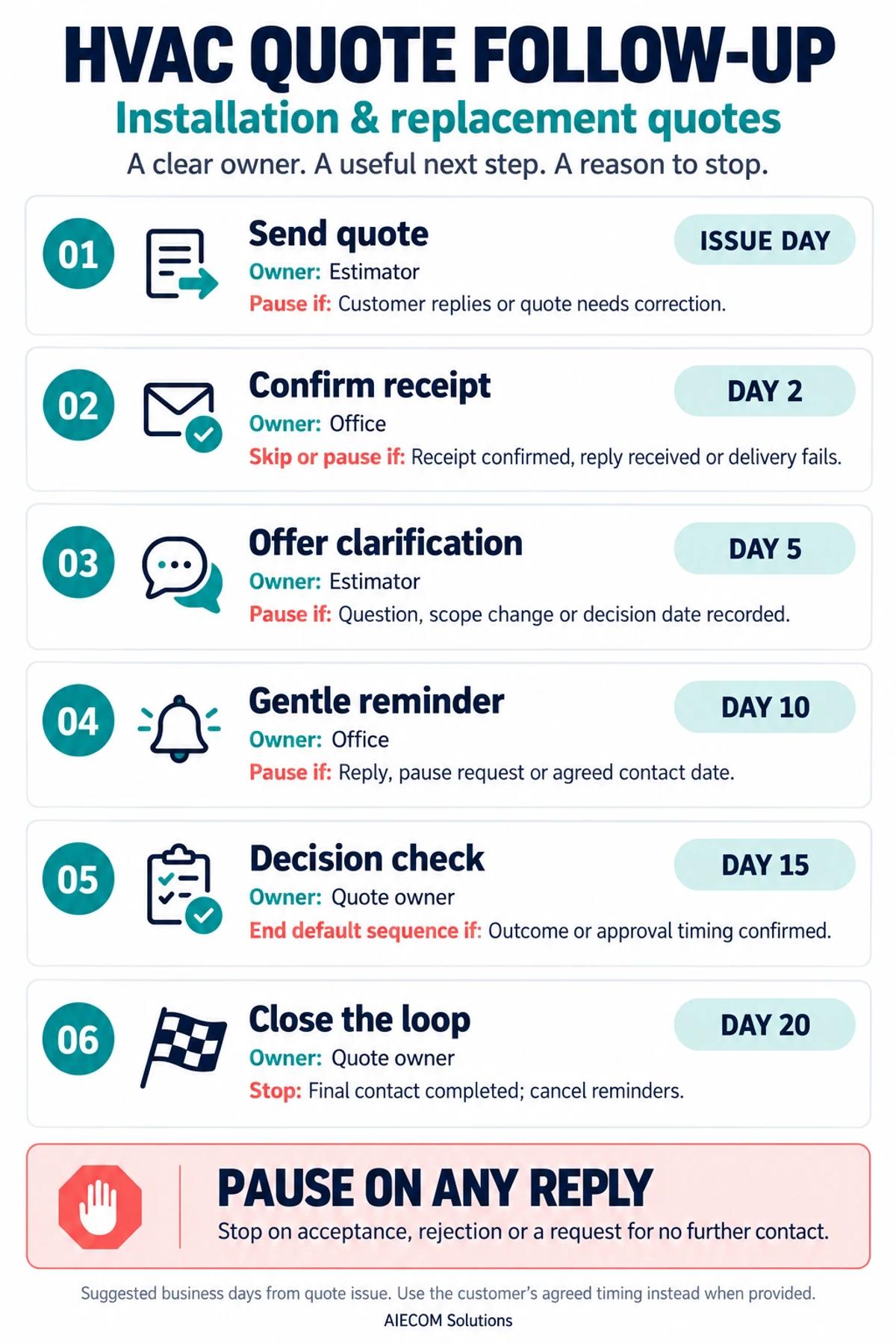
A practical HVAC quote follow-up cadence gives every contact a purpose, a responsible person and a reason to stop.
The timing below is a suggested starting point, not an industry benchmark. Count business days from the quote’s issue date, and replace the default schedule whenever the customer agrees to a different date.
Any reply should pause scheduled reminders for review. Acceptance, rejection or a request for no further contact should end the sequence.
Step 1: Acknowledge the request and send the quote
The first message should connect the quote to the customer’s property, proposed work and next decision.
Suggested timing: When the checked quote is issued.
Owner: Estimator or quoting coordinator.
Stop condition: Do not advance until the correct quote has been sent; pause immediately if the customer replies.
Include the quote reference and a short description of the work. Only mention inclusions that appear in the actual document.
Hi [First name],
Thanks for discussing the air conditioning replacement at [Property]. Your quote [Reference] is attached and sets out the proposed work, inclusions and exclusions.
Is there a particular date you’re working towards? If anything needs explaining, reply here and I’ll arrange for [Estimator] to help.
Step 2: Confirm receipt
The receipt check should establish whether the customer received the document and can access it.
Suggested timing: Two business days after issue, if receipt is unconfirmed.
Owner: Office coordinator.
Stop condition: Skip if receipt is already confirmed; pause if the customer replies or the email fails.
Avoid treating an email-open notification as confirmation that the customer has reviewed the quote.
Hi [First name],
Did quote [Reference] for your split-system installation come through? If the attachment won’t open, let me know and I’ll resend it.
If you’ve already received it, there’s nothing else you need to do at this stage.
Step 3: Offer help with the decision
The questions stage should make it easy to identify what the customer needs explained.
Suggested timing: Around five business days after issue, if no conversation is underway.
Owner: Estimator.
Stop condition: Pause when a question, revised scope or agreed decision date is recorded.
Keep technical explanations with the person responsible for the quote. The office team can organise the conversation without improvising answers about system selection.
Hi [First name],
Is there anything in the ducted replacement quote you’d like us to explain, such as the proposed scope or what is excluded?
If you’re comparing options, tell me which part is unclear and I can help clarify our proposal.
Step 4: Send a gentle reminder
The reminder should reconnect the proposal with the customer’s plans and offer a simple next step.
Suggested timing: Around ten business days after issue.
Owner: Office coordinator, with estimator support.
Stop condition: Skip if the customer has responded, requested a pause or agreed to another contact date.
Do not add unsupported claims about dwindling stock or a nearly full installation calendar.
Hi [First name],
Is the air conditioning installation at [Property] still part of your plans?
If you’re considering going ahead, we can check current availability. If the project has moved back, let me know when it would be useful to reconnect.
Step 5: Check the decision status
The decision check should establish whether the quote is active, postponed or no longer required.
Suggested timing: Around fifteen business days after issue.
Owner: Estimator or nominated sales owner.
Stop condition: Record the outcome and end the default sequence when the customer answers.
For commercial work, ask about the approval process without assuming the person receiving the quote can authorise it.
Hi [First name],
Are you still considering quote [Reference], waiting on approval, or putting the replacement on hold?
If another person needs information about our proposed work, let me know what would help. Otherwise, I can update our records to reflect your plans.
Step 6: Close the loop
The final message should end routine reminders while leaving a clear route back to the business.
Suggested timing: Around twenty business days after issue, following an owner review.
Owner: Quote owner.
Stop condition: Mark the quote “closed—no response” and cancel remaining reminders.
Closing the follow-up record does not automatically cancel the quote or change its stated validity. Review the actual quote terms separately.
Hi [First name],
I haven’t heard back about quote [Reference], so I’ll close off our routine follow-up for now.
If the replacement is still on your list, you’re welcome to get back in touch. We can review the quote and check current pricing and availability before discussing the next step.
3. Automate reminders while keeping decisions human
Quote follow-up automation should support reliable administration while leaving scope, pricing and customer questions with the appropriate person.
Automate tasks and checks your system can support
Start with internal reminders if your system cannot reliably detect replies, acceptance or changes in quote status.
Useful candidates for automation include:
- Assigning a quote owner.
- Creating the next follow-up task.
- Flagging quotes without a next action.
- Preparing an approved message for review.
- Cancelling pending reminders after a recorded outcome.
- Showing overdue tasks to a backup owner.
For lead capture and automated follow-up, the handover between enquiry, site visit and quote matters as much as the message itself. Keep the property, service type, quote version and responsible person together.
Before enabling automatic sending, test what happens when someone replies by phone instead of email. A phone conversation recorded by the office should also prevent an irrelevant reminder.
Keep scope changes and commitments with a person
A person should review anything that changes the proposal or commits the business to an outcome.
That includes:
- Questions about split-system or ducted options.
- Changes to installation scope.
- Requests for a revised price.
- Proposed installation dates.
- Commercial approval requirements.
- Complaints or dissatisfaction with the quote.
A revised quote should replace the earlier version in the active record. Agree on a fresh follow-up date instead of allowing the original sequence to continue.
4. Adjust air conditioning quote follow-up to the job
Air conditioning quote follow-up should reflect the customer’s project and decision process.
Split-system installation and replacement
For split-system work, establish whether the customer is ready to decide or still clarifying the proposal.
A bedroom installation may be waiting on renovation timing, while replacement of a failed living-room unit may need a prompt conversation. Ask about the desired timing and record the answer.
Use one relevant question per message. Sending a long questionnaire after quoting can make a straightforward decision harder to manage.
Ducted replacement and commercial work
For ducted and commercial quotes, identify who needs to review the scope and what information they require.
A facilities manager might need a proposal that clearly separates equipment replacement from ongoing maintenance. A property manager might be waiting for the owner’s decision.
Keep related opportunities distinct. Acceptance of replacement work should not automatically count as acceptance of a maintenance agreement.
Seasonal peaks
During seasonal peaks, review your ability to answer replies before increasing follow-up activity.
A reminder can restart a conversation that needs an estimator’s attention. Assign cover for quote questions and check current scheduling information before discussing availability.
Use the HVAC summer peak preparation checklist alongside your quote review so follow-up remains connected to office capacity and installation planning.
5. Track quote-to-win by service type
Quote-to-win reporting is more useful when it separates comparable work and uses a consistent definition.
Group quotes before calculating conversion
Separate your reporting into service types such as split-system installation, split-system replacement, ducted installation, ducted replacement and commercial work.
Keep repairs and maintenance agreements in their own categories if you also quote those services. Their decision processes may differ from installation projects.
For a defined group of issued quotes:
Quote-to-win rate = accepted quotes ÷ issued quotes × 100
Define what “accepted” means in your business and apply that rule consistently. Count one opportunity once, even when it has several quote revisions.
Review outcomes alongside the conversion rate
The conversion rate needs context from open quotes, decision times and recorded reasons.
Review:
- Accepted, declined, postponed and no-response outcomes.
- Quotes still awaiting a decision.
- Time from issue to acceptance.
- Missing owners or overdue actions.
- Customer-stated reasons for declining.
- Questions that repeatedly require clarification.
Compare groups with enough time to reach a decision. A recently issued commercial proposal should not be treated as unsuccessful simply because it remains open.
These measures can reveal process gaps, but a change in conversion alone does not prove that follow-up caused it.
6. Avoid common quote follow-up mistakes
The most common mistakes come from contacting customers without checking their current status or offering useful information.
Repeating generic nudges
Repeated “any update?” messages give the customer no new way to move forward.
Give each contact one purpose: confirm receipt, answer a question, establish timing or record a decision. To follow up HVAC quotes consistently, improve the task definition before increasing message frequency.
Sending after a conversation has already moved on
An automated reminder becomes confusing when the customer has already accepted, declined or spoken to the estimator.
Update the shared record after every meaningful conversation. Check pending tasks whenever a quote changes status.
Using pressure or unsupported promises
Follow-up should not imply that stock, pricing or installation availability is limited unless someone has verified the claim.
Likewise, avoid using a template to promise lower running costs, a particular system outcome or a guaranteed installation date. Refer questions back to the estimator and the checked proposal.
Treating every unanswered quote as lost on price
A lack of response does not identify the customer’s reason.
Keep “no response” separate from confirmed price objections. Otherwise, your reporting may encourage discounting when the unresolved issue was timing, scope or approval.
7. Use a one-page follow-up template
A one-page template gives the office and estimator a shared record of ownership, timing and outcomes.
Copy the following into your working document, print it or save it as a PDF.
HVAC installation and replacement quote follow-up sheet
This sheet records the next useful action for one quote opportunity.
Customer/property: __________
Quote reference/version: __________
Service type: __________
Issue date/stated validity: __________
Quote owner/backup: __________
Preferred contact channel: __________
Customer’s decision date: __________
Known question or approval needed: __________
Current status: __________
Next action/date/owner: __________
Last conversation: __________
Outcome and customer-stated reason: __________
Operating rule: Days are suggested business days from issue. Pause scheduled messages on any reply; stop on acceptance, rejection or a request for no further contact.
8. What good HVAC quote follow-up looks like
Good follow-up gives every active quote an owner, a useful next action and a clear stopping point.
Your office can see who needs help, your estimator can see which questions remain open, and the customer receives messages that reflect the conversation so far. No one has to reconstruct the decision from separate inboxes.
Start with a manageable group of installation and replacement quotes. Review the responses, missed handovers and outcomes before expanding the process.
Ready to see where your HVAC lead flow is breaking down? request an HVAC growth audit with AIECOM Solutions.
9. Frequently asked questions
These answers explain how to adapt the cadence without turning it into an inflexible series of reminders.
How often should you follow up HVAC quotes?
Use a short sequence with a distinct purpose for each contact, then adjust it to the customer’s agreed timing. The suggested cadence above covers receipt, clarification, a reminder, a decision check and closure over roughly twenty business days. It is a starting point, not a performance benchmark. Pause whenever the customer replies and replace default dates with agreed ones.
What should an HVAC quote reminder email include?
An HVAC quote reminder email should identify the quote, refer to the proposed installation or replacement, and ask one useful question. Include the sender’s name so the customer knows who owns the conversation. Avoid repeating the full proposal or adding unverified availability claims. Where the customer has already raised a question, answer that question before sending another reminder.
When should you stop following up an air conditioning quote?
Stop when the customer accepts, declines or asks for no further contact. Pause when they request more time, raise a question or give you a decision date. If there is no response after your defined sequence, close routine follow-up and record that outcome separately from a confirmed rejection. Keep the quote’s stated validity separate from its follow-up status.
Can quote follow-up automation handle the whole process?
Automation can support task creation, approved reminders and status checks where your system has those capabilities. A person should still handle technical questions, revised scope, pricing decisions and installation commitments. Before enabling automatic messages, test whether replies and offline conversations reliably pause the sequence. If they do not, use automation to prompt staff to review and send each message.
NEXT STEP
Ready to Work With a Team That Actually Delivers?
Book a free strategy call. No pitch. Just honest advice.