Automation & Systems
Emergency vs Planned Plumbing Enquiries: How to Design Two Lead Paths That Fit the Work
5 October 2026

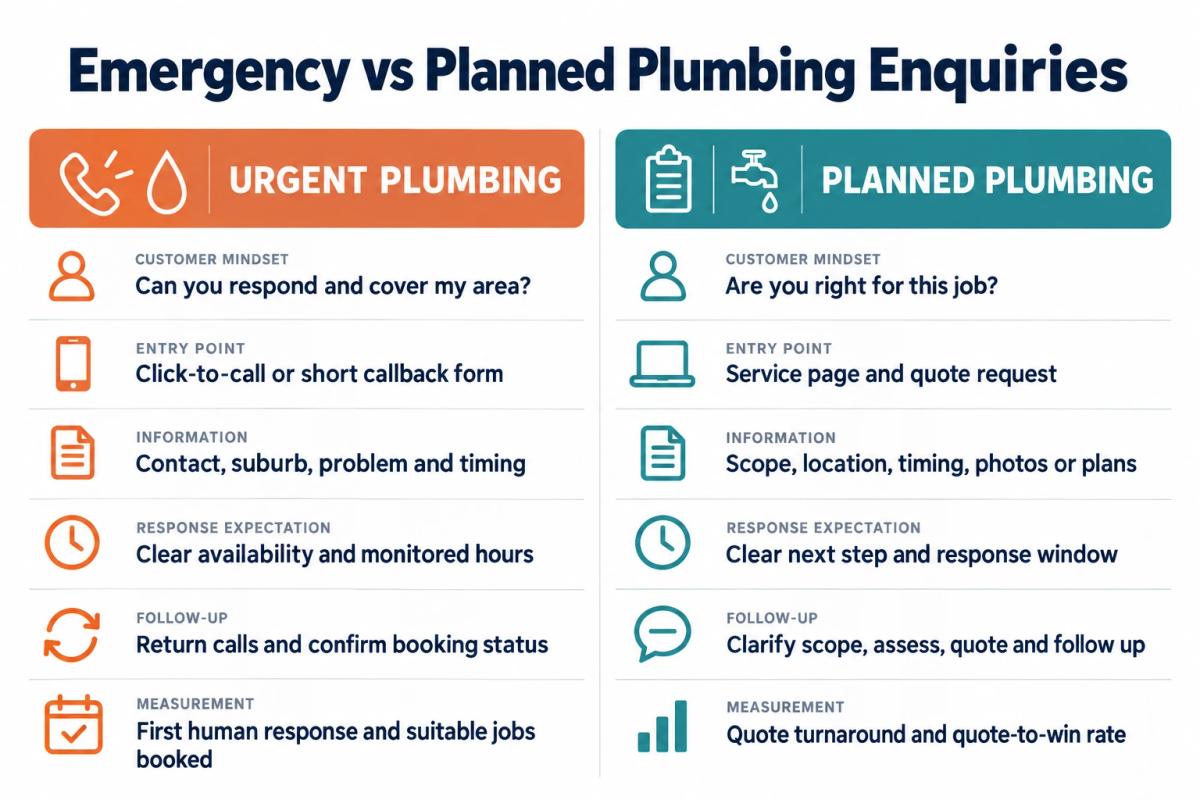
Emergency vs planned plumbing enquiries need different contact paths because customers have different priorities, information and expectations. Someone reporting a blocked drain wants to know whether you cover their area and can respond; someone planning a bathroom renovation needs confidence in your work and a clear quoting process.
Putting both customers through the same contact form leaves your office to untangle urgency, scope and responsibility. Our approach to plumbing marketing services in Australia starts with matching the enquiry experience to the work your business actually accepts.
The practical solution is two clear entry points connected to one organised enquiry process. Urgent work needs a short route to an availability conversation, while planned work needs useful scope questions, an assigned quote owner and structured follow-up.
1. Emergency vs planned plumbing enquiries: what changes?
The main differences are the customer’s immediate question, the information needed to act and the next step your team should offer. Design around those differences before choosing forms or automation.
A hot water enquiry illustrates why service names alone are insufficient. A customer reporting a failed system may want an urgent availability check, while someone researching a replacement for next month needs a planned assessment.
Let customers choose without diagnosing the fault
Ask customers about the help they want and their preferred timing, rather than requiring a technical diagnosis. “Blocked drain”, “hot water problem”, “leak” and “not sure” are more usable starting points than specialist fault categories.
Offer choices such as “Ask about urgent availability” and “Plan a job or request a quote”. These describe the next action without implying that a plumber has already been allocated.
2. Design the urgent path around availability
Urgent plumbing enquiries need a direct way to contact the team and establish whether the business can take the job. Keep the page focused on location, service suitability, availability and contact.
Put click-to-call where customers can find it
Make the phone number and call button prominent on pages for urgent work, particularly on mobile. A customer reporting an overflowing drain should not have to navigate through renovation galleries to find your contact details.
Use button wording that matches the conversation, such as “Call to check availability”. If you provide a callback form, explain that submitting it does not confirm a booking or arrival time.
For example, the confirmation could say: “Your callback request has been received. Our team will contact you during the hours shown above to discuss availability.”
Check the service area early
Capture the suburb or postcode near the start so the team can establish whether the address is within coverage. A service-area check should help customers understand eligibility without presenting coverage as a promise of immediate attendance.
If appropriate to its verified functionality, place the service-area check tool beside the urgent contact options. Confirm that its coverage information reflects the areas your team currently serves.
Allow uncertain addresses to be checked by a person. Boundary suburbs, commercial sites and strata properties may need clarification before the office can accept the enquiry.
Explain after-hours handling before submission
State whether calls and forms are monitored after hours, and describe what happens when someone contacts you outside those hours. An automatic receipt should never be presented as confirmation that a plumber is responding.
If you have an after-hours process, identify who receives the enquiry and how acceptance is confirmed. If forms are reviewed during office hours only, make that visible beside the submit button.
Publish only availability claims your operations support. Check your state or territory requirements before publishing any legal, licensing or safety statements.
3. Keep forms short, but capture useful context
The right form collects enough information for the next decision without asking the customer to complete the whole job assessment. Urgent and planned forms can share basic fields while asking different follow-up questions.
Limit urgent forms to the immediate handover
An urgent callback form should help the person responding identify the customer, location, problem and requested timing. Start with:
- Name.
- Callback number.
- Suburb or postcode.
- Broad problem type, including “not sure”.
- Whether help is requested now or at a later time.
Keep photos and longer descriptions optional unless they are essential to your intake process. A customer should be able to request a conversation without measuring pipework or finding property plans.
Use conditional questions for planned work
Planned forms should reveal questions that relate to the selected job. A bathroom renovation enquiry needs different context from a strata maintenance request.
For a renovation, ask about the project stage, plumbing scope, preferred timing and available plans. For strata maintenance, ask about the property, recurring issue, site contact and person coordinating the work.
The guide to what to put on a plumber's enquiry form is the related form-design reference. When reviewing your fields, ask whether each answer changes routing, preparation or the next conversation.
4. Build the planned path around scope and confidence
Planned plumbing enquiries need enough context for customers to judge suitability and for your team to organise the next step. The service page and quote process should work together.
Show relevant work before asking for a quote request
Use verified examples that relate to the service being considered. Bathroom renovation customers may benefit from project photos and a description of the plumbing scope, while commercial maintenance buyers may need an explanation of your assessment and coordination process.
Describe what your business actually handles. Avoid implying that you manage an entire renovation if your role is limited to plumbing work.
Where you publish project results, testimonials or customer images, verify the details and permission to use them. Leave unsupported proof out rather than replacing it with broad claims.
Explain what happens after the request
Tell customers whether the next step is a phone discussion, a request for plans or an assessment. “Request a quote” should not imply that every submission contains enough information to price the work.
For a bathroom renovation, your team might first clarify fixture locations and the project stage. For commercial maintenance, the first conversation might establish the sites involved and the type of work required.
Give a response window only when someone owns it and can maintain it. Separate the time to acknowledge an enquiry from the time needed to prepare a quote.
Give quotes a follow-up process
Assign every planned enquiry to a person responsible for moving it towards a decision. That person should know whether the enquiry is waiting for information, an assessment, pricing or a customer response.
Use the plumbing quote follow-up cadence as the related reference when setting follow-up stages. Adapt the timing to the project and any decision date the customer has provided.
Keep messages connected to the actual scope. Asking whether a renovation’s start date has changed is more useful than repeatedly sending “just checking in”.
5. Set plumbing lead routing rules and ownership
Plumbing lead routing should direct each enquiry to someone who can take the next action, with a fallback when that person is unavailable. Start with simple rules your office can explain.
Route by service, suburb and customer type
Use service and requested timing to identify the enquiry path, then use location and customer type to refine the handover. Customer type should add context rather than automatically override urgency.
A practical routing order is:
- Check the requested service and timing.
- Check whether the location is within coverage.
- Identify whether the enquiry concerns a homeowner, property manager, strata scheme, builder or commercial customer.
- Assign an owner and next action.
For example, a builder’s bathroom project may go to the estimator, while a property manager reporting a current leak may need an availability conversation. Both should retain the original enquiry details.
Assign a primary owner and a fallback
Give urgent enquiries an owner who can check availability, and planned enquiries an owner who can progress assessment and quoting. In a small business, this may be the same person, but the responsibilities should remain clear.
Record an owner, status and next action for every enquiry. A shared inbox alone does not show whether someone has taken responsibility.
Services covering lead capture and automated follow-up can support this process once the rules are defined. Before relying on any automation, test the actual notification, assignment and failure-handling behaviour.
6. Measure each path against its next decision
Measure whether enquiries progress to an appropriate next step, rather than treating every form submission as an equally valuable outcome. The urgent path centres on response and availability; the planned path centres on scope, quotes and decisions.
Track human response on urgent enquiries
Measure the time between receiving an enquiry and the first human response. Keep automatic acknowledgements separate so they do not make response performance look better than it is.
Also track missed calls returned, suitable enquiries booked and reasons work was not accepted. Distinguish outside-area enquiries from jobs declined because no suitable appointment was available.
Review results against your published monitoring hours. A next-morning callback means something different for an office-hours service than for an advertised after-hours operation.
Track quote progression on planned enquiries
Measure how many suitable enquiries reach assessment, receive a quote and become accepted work. Include quote turnaround and enquiries waiting for information so you can identify where progress stops.
Define quote-to-win consistently. One option is accepted quotes divided by quotes with a recorded decision, while reporting undecided quotes separately.
Keep urgent and planned results separate within your broader 90-day plumbing marketing plan. More callback requests should not hide a backlog of unanswered renovation enquiries.
7. Avoid the mistakes that blur the two paths
The most common design mistakes leave customers unsure what to do or leave staff unsure who should respond. Review the handover as carefully as the page itself.
- One generic form for everything: Add an early choice between urgent availability and planned work.
- Long forms on urgent pages: Move detailed scope questions to the planned path or a later conversation.
- No owner for planned quotes: Assign responsibility when the enquiry arrives.
- Unqualified availability claims: Make published hours and contact expectations match actual coverage.
- Automatic receipts treated as responses: Report acknowledgement and human contact separately.
- Duplicate follow-up: Give staff visibility of previous contact and outstanding actions.
- Service labels used as urgency rules: Ask about timing because leaks, hot water and drains can involve urgent or planned work.
Test the full journey using plumbing scenarios. Follow a blocked-drain callback request, a bathroom renovation enquiry and a strata maintenance request through to their assigned owners.
8. What good looks like
A well-designed enquiry process makes the next step clear to both the customer and the team. Customers can choose an appropriate route, understand contact expectations and provide information relevant to their job.
Inside the business, each enquiry has an owner, a status and a next action. Urgent requests reach someone who can discuss availability, while planned work remains visible through assessment, quoting and follow-up.
Start with those basics, then refine the process using actual enquiries and staff feedback. Add automation where it supports a defined action and where its behaviour has been tested.
Want urgent and planned enquiries to reach the right person with the right context? Discuss your plumbing enquiry paths with AIECOM Solutions and request a plumbing growth audit.
9. Frequently asked questions
These answers cover practical choices when setting up separate plumber website contact paths.
Should emergency and renovation enquiries share one form?
They can share one underlying form if an early choice changes the questions and routing. For a plumbing call-out vs renovation enquiry, show short contact and location fields for the urgent path, then scope and timing questions for renovation work. Separate forms may be easier to maintain if the journeys differ substantially. Either approach needs clear ownership and contact expectations.
Do I need after-hours automation?
You need a clear after-hours process before deciding whether automation helps. If someone monitors enquiries, automation may support notifications or acknowledgements, depending on the system’s verified capabilities. If nobody responds until office hours, say so clearly. An automated receipt should explain what happens next without suggesting that attendance is confirmed or that a person has reviewed the request.
What if a customer chooses the wrong enquiry path?
Let staff reclassify the enquiry without making the customer submit everything again. Preserve the original details, update the owner and explain the next step where needed. An enquiry submitted as urgent may become a scheduled appointment after discussion, while a planned maintenance request may need earlier attention. Include a “not sure” option so customers are not forced into a technical judgement.
Which measure should I improve first?
Start with the point where enquiries are losing momentum. For urgent work, check unanswered calls and time to first human response. For planned work, check unassigned enquiries, delayed quotes and quotes without a next action. Establish a baseline from your own records before choosing a target, and separate unsuitable enquiries from work your business could reasonably accept.
NEXT STEP
Ready to Work With a Team That Actually Delivers?
Book a free strategy call. No pitch. Just honest advice.