Growth Marketing
Plumbing Marketing in Australia: A Practical 90-Day Plan for More Qualified Enquiries
19 September 2026

A 90-day plumbing marketing plan sets out which jobs you want, how suitable customers will find you, and how your team will turn enquiries into booked work. Start by fixing service information, enquiry handling and measurement before increasing advertising spend.
The problem is not always a shortage of calls. A blocked-drain enquiry outside your service area, a bathroom renovation you cannot schedule, or a hot water enquiry nobody returns can all consume time without becoming suitable work.
This plan connects marketing with the way your plumbing business operates. If you need help putting it into practice, AIECOM Solutions’ plumbing marketing services in Australia bring the website, marketing and enquiry process into the same conversation.
1. Build your plumbing marketing plan around the work you want
Your plan should start with a clear choice about services, customers and capacity. “More plumbing enquiries” is too broad to guide your website, advertising or office team.
Choose your priority work
Choose one or two service priorities for the first 90 days, based on the work your business can deliver profitably and consistently.
Review recent jobs with the people doing the work and handling bookings. Consider travel, materials, quoting time, scheduling and the effort required to coordinate access.
Your shortlist might include:
- Blocked drains and repairs: enquiries about a specific problem requiring assessment.
- Hot water systems: repair or replacement enquiries with different urgency and information needs.
- Bathroom renovations: planned projects involving scope, timing and coordination with other trades.
- Residential maintenance: smaller jobs that need practical scheduling.
- Strata and commercial plumbing: work involving site contacts, approvals, access and reporting.
Write a simple priority statement: “We want more scheduled hot water replacement enquiries within our existing service area.” Treat that as an example to adapt, not a recommendation for every business.
Check capacity before creating demand
Your marketing priorities should match the appointments, quoting time and phone coverage you can actually provide.
Check the diary with your operations or office manager before launching campaigns. Include existing customer commitments and time needed for site visits.
Agree on:
- Which services have room for additional bookings.
- Which locations make operational sense.
- Who answers calls during advertised hours.
- Who handles missed calls and website enquiries.
- How much quoting work the team can manage.
If the team is occupied with bathroom renovations, advertising emergency call-outs may create enquiries you cannot service. Change the campaign focus or wait until suitable capacity exists.
Define a qualified enquiry
A qualified enquiry is a genuine request that fits your service, location, timing and customer requirements.
For a blocked drain, qualification might establish the property location, reported issue and requested attendance time. For a renovation, it might establish the project stage, plumbing scope and expected programme.
Use clear outcomes such as qualified, unsuitable, duplicate or awaiting information. Record the reason for unsuitable enquiries so you can distinguish a marketing mismatch from a temporary capacity problem.
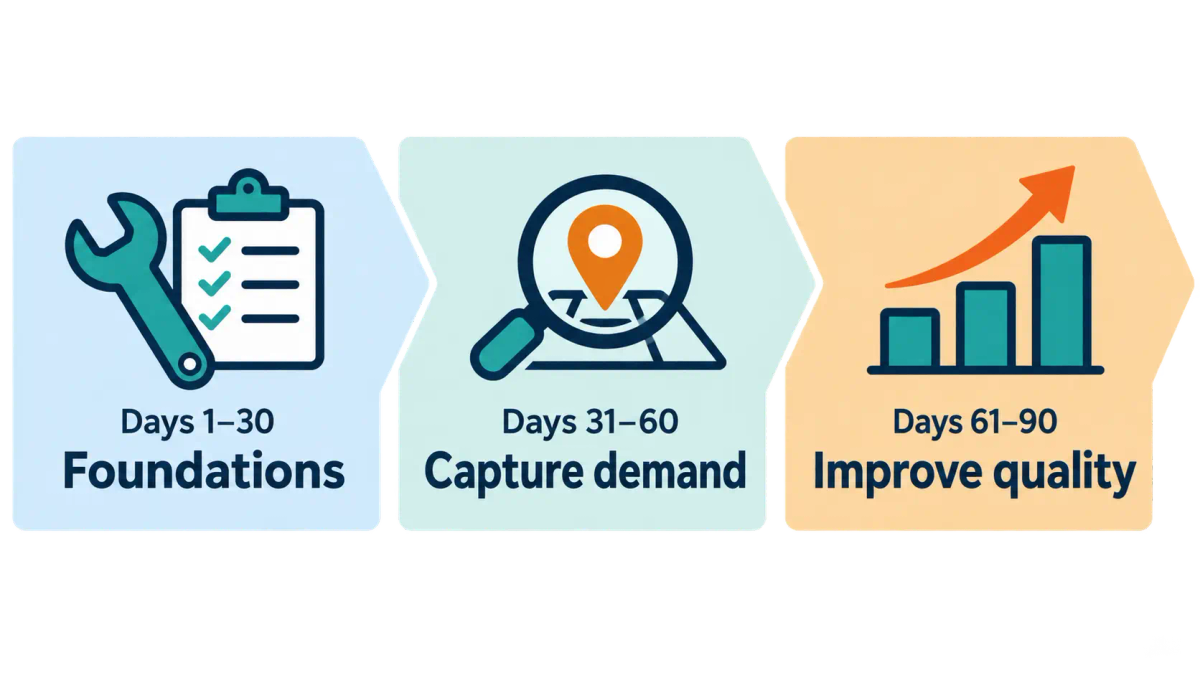
2. Days 1–30: Fix the foundations
The first month should make your priority services easier to understand, your business easier to contact and your enquiries easier to review.
Establish a usable baseline
Your baseline should connect each genuine enquiry with its source, service and eventual outcome.
Start with recent records you can reasonably reconstruct, then track new enquiries consistently. Use a shared spreadsheet or your existing system; incomplete historical information should stay marked as unknown.
Capture:
- Date received and first human response.
- Enquiry source, where known.
- Requested service and property suburb.
- New or existing customer.
- Qualified status and reason.
- Next action and responsible person.
- Quote status.
- Job won, lost or still open.
- Recorded loss reason, where available.
Keep repeat contact about the same job attached to one enquiry. A customer who calls after submitting a form should not automatically count as two opportunities.
Build or improve priority service pages
Each priority service page should explain the work, who it suits and what happens after an enquiry.
A blocked-drain page should help someone understand how to request an assessment. A bathroom renovation page should help an owner or builder understand what project information to provide.
Useful page content includes:
- The services you actually offer.
- Your genuine service area.
- The information needed to assess an enquiry.
- Your booking or quoting process.
- Relevant photographs you have permission to publish.
- Clear answers to common customer questions.
- A visible next step.
For hot water work, distinguish enquiries about an existing system from planned replacement discussions. Avoid publishing prices, turnaround promises or equipment capabilities that the business has not confirmed.
Make the conversion path straightforward
Your conversion path should let a suitable customer contact you without searching through the website.
Test priority pages on a phone. Check the call button, enquiry form, confirmation message and delivery of the enquiry to the person responsible.
For urgent work, make the telephone option prominent during the hours you actually cover. For planned work, offer a form that collects enough information to arrange the next conversation.
Start with name, contact details, property suburb, service and a short description. Ask for renovation plans or detailed commercial information later if collecting everything immediately would make the initial form cumbersome.
The free plumbing website tools provide options to review alongside your enquiry forms. Check each tool’s purpose and assumptions before incorporating it into the customer journey.
If navigation, layout or inconsistent presentation is getting in the way, consider website design and branding for plumbing businesses. For a broader review, use 12 signs it is time to upgrade your website to structure the discussion.
Make enquiries traceable
Traceable enquiries need a reliable record of contact and outcome, not just a count of website interactions.
Separate call-button clicks from actual conversations and form submissions from qualified enquiries. A click shows an action on the website; your office records establish whether there was a suitable job.
Where source information is available, carry it into the enquiry record. Ask “How did you hear about us?” when useful, while recognising that customers may have encountered the business more than once.
Plan lead capture and automated follow-up around this record, with a named person responsible for the next action. Confirm what your current systems support before choosing additional software.
Establish a weekly review
A weekly review should identify missed opportunities and assign a practical fix.
Have the owner and office manager review unanswered enquiries, unsuitable requests, outstanding quotes and booked work. Select a manageable improvement, give it an owner and check it the following week.
By day 30, you should have clear priority pages, tested contact routes and a baseline that the team can maintain.
3. Days 31–60: Capture relevant demand
The second month should help suitable customers find the services you prioritised and reach a relevant next step.
Keep local business information accurate
Your local visibility work should start with accurate business details and useful information about the services you deliver.
Review your Google Business Profile, website and important business listings for consistent contact details and current hours. Check that service descriptions reflect the work you want and can accept.
Use photographs that show your actual team, vehicles or completed work where appropriate and permitted. Remove outdated availability statements and services you no longer provide.
Build local relevance through useful service information and genuine experience. Avoid producing near-identical pages that only swap suburb names.
Run a selective Google Ads test
A selective advertising test should focus on a defined service, an appropriate area and a measurable enquiry outcome.
For example, a planned hot water replacement campaign should send visitors to relevant replacement information. Someone searching for bathroom renovation plumbing should reach a page explaining scope and project enquiries.
Before starting:
- Choose the service and customer need.
- Confirm capacity and enquiry coverage.
- Set a spending limit the business can sustain.
- Match the advertisement to the destination page.
- Test contact and tracking routes.
- Define how qualified enquiries will be reviewed.
Check location settings carefully and compare actual enquiry locations with your intended service area. Google notes that location targeting uses multiple signals and is not completely accurate, so settings still need review. See Google’s location-targeting guidance.
Review available search-term information alongside your enquiry records. If a campaign repeatedly attracts people looking for plumbing jobs, training or products you do not sell, investigate the targeting and exclusions.
Judge the test on qualified enquiries and subsequent outcomes. Cheap clicks alone do not establish whether the campaign suits your business.
Publish content that supports a decision
Decision-stage content should answer questions people ask before booking an assessment or requesting a quote.
Start with questions your office already handles. Useful plumbing marketing ideas include:
- What information should I provide when booking a blocked-drain assessment?
- What should I have ready for a hot water replacement enquiry?
- What does a plumber need to quote bathroom renovation work?
- How should a property manager submit several maintenance requests?
- What should a strata manager include in a plumbing work brief?
Explain the information needed and the next step in your process. Keep technical diagnosis and repair instructions out of marketing content, and check your state or territory requirements where relevant.
A renovation article, for example, could explain why the team asks for plans, the proposed layout and the builder’s contact details. Link it to the relevant service page so readers can act on the information.
Coordinate channels around the same priority
Your website, local visibility, advertising and content should support the same service priorities during each test period.
If you are seeking strata maintenance work, use content and enquiry forms that recognise access arrangements, site contacts and reporting needs. A generic emergency plumbing message does not explain that offer.
Where specialist help is needed, SEO, paid ads and content marketing support can provide a coordinated starting point. Keep the brief focused on suitable work and measurable enquiry outcomes.
4. Days 61–90: Improve enquiry quality and follow-up
The final month should use your records to improve the fit of incoming work and the handling of opportunities already received.
Compare quality by source and service
Compare enquiry sources by qualification and job outcomes before deciding where to increase effort or spending.
Review each priority service separately. Hot water repair enquiries and bathroom renovation enquiries should not be treated as identical buying decisions.
Useful measures include:
- Qualified enquiry rate: qualified enquiries divided by genuine enquiries.
- Response time: time between receipt and the first human response.
- Quote outcomes: accepted, declined and still awaiting a decision.
- Cost per qualified enquiry: the stated acquisition cost divided by attributed qualified enquiries.
Label costs clearly so an advertising-only calculation is not mistaken for total marketing cost. Keep unknown sources visible and avoid firm conclusions from a small number of enquiries.
For quote comparisons, use a consistent group of quotes and report pending decisions separately. A renovation quote still under consideration should not automatically be recorded as lost.
Investigate why suitable work is not progressing
The reason an enquiry stalls should determine the next improvement.
Review a sample of qualified enquiries that did not become booked work. Look for recorded evidence rather than assuming that price was the problem.
Possible issues include:
- The requested appointment was unavailable.
- The customer could not reach the right person.
- The quote did not clearly describe the scope.
- The property manager was waiting for owner approval.
- A builder had not finalised the renovation programme.
- The next action was never assigned.
Fix the stage where the problem occurred. More advertising will not resolve an unassigned quote follow-up.
Make quote follow-up useful
Useful follow-up helps the customer understand the quote and tells your team what should happen next.
Agree on a process that suits the work:
- Confirm the quote has been sent to the correct contact.
- Make it clear how the customer can ask questions.
- Record an appropriate follow-up date.
- Check for missing information or unresolved scope.
- Update the outcome and next action.
For bathroom renovations, ask whether the plans or programme have changed. For strata work, establish whether the quote is awaiting review, clarification or a decision from another party.
Use automated acknowledgements and internal reminders where your systems support them. An acknowledgement should confirm receipt without implying that an appointment has been booked.
Set the next monthly operating cycle
Your ongoing cycle should repeat the decisions that proved useful during the first 90 days.
At the end of each month, review capacity, enquiry quality, quote outcomes and acquisition costs. Choose the next service priority and a small set of changes.
Keep an owner and review date against each action. This turns the plan into a routine the business can continue.
5. Adapt the plan to the type of plumbing work
Different plumbing services need different enquiry paths, information and follow-up.
Emergency call-outs and repairs
Emergency marketing should reflect the hours, locations and call handling your team can actually provide.
Prioritise clear contact details and a brief qualification process. Record whether an enquiry was unsuitable or simply arrived when the team had no capacity.
Do not advertise round-the-clock attendance unless the business can substantiate that offer.
Hot water and bathroom renovations
Hot water and renovation enquiries should be separated by urgency, scope and project stage.
For hot water work, establish whether the customer is reporting a problem or planning a replacement. For renovations, ask about the proposed work, available plans, builder involvement and timing.
Keep renovation follow-up aligned with the project’s decision process rather than an emergency booking script.
Residential maintenance and property management
Maintenance marketing should make it easy to submit a clear work request and arrange access.
Ask for the property location, reported issue, contact person and relevant access information. For property managers, explain your actual process for work orders, updates and completion information.
Only promise reporting or communication services the team can consistently deliver.
Strata and commercial work
Strata and commercial marketing should explain how your business handles coordination as well as plumbing enquiries.
Provide a clear route for scope documents, site information and discussions about ongoing work. Ask who coordinates access, reviews quotes and receives updates.
Use verified project examples where available, with permission and an accurate description of your role.
6. Avoid these common plumbing marketing mistakes
The most useful corrections address mismatches between what marketing attracts and what the business can deliver.
- Promoting every service equally: choose priorities that match current capacity.
- Sending every advertisement to the homepage: give visitors information relevant to their enquiry.
- Counting every contact as a lead: separate genuine opportunities from duplicates and unsuitable requests.
- Advertising areas that are impractical to service: review travel and scheduling before expanding.
- Leaving enquiries without an owner: assign responsibility and a next action.
- Treating all quotes as immediate decisions: distinguish urgent repairs from planned projects.
- Publishing generic suburb pages: provide useful service information and genuine local context.
- Using unsupported claims: verify availability, capabilities, testimonials and project descriptions.
- Changing everything at once: keep a record of changes so results remain interpretable.
The aim is a repeatable plumbing marketing strategy for Australia that fits your business, rather than a collection of unrelated activities.
7. What good looks like after 90 days
A useful outcome after 90 days is a clearer view of which enquiries suit your business and a more reliable process for handling them.
You should be able to identify your priority services, explain where suitable enquiries come from and see which opportunities need attention. Your website should describe the work accurately, and your office team should know who owns each next step.
Your review should answer:
- Are enquiries better matched to our services and area?
- Are customers receiving a timely human response?
- Are quotes progressing or sitting unresolved?
- Which activities deserve another test?
- Can our team fulfil the work we are promoting?
You may still have unanswered questions, particularly where enquiry volumes are low or projects take longer to decide. Record those limits and use the next month to gather better evidence.
Ready to see where your plumbing lead flow is breaking down? Request a plumbing growth audit with AIECOM Solutions.
8. Frequently asked questions
These answers explain how to apply the plan when time, budget and capacity are limited.
How long does plumbing marketing take to produce results?
There is no fixed timeframe for qualified enquiries or booked jobs. Fixing a broken contact form can remove an immediate obstacle, while organic visibility and planned-project decisions may take longer to develop. Use the first 90 days to establish reliable measurement, test focused activity and review outcomes. Compare similar services and keep pending quotes separate from confirmed losses.
Does my plumbing business need a blog?
A blog is useful when it answers real customer questions and supports relevant service pages. It should not take priority over accurate service information, working contact options or enquiry follow-up. Start with questions about booking, quote preparation, renovation scope or property maintenance requests. Publish when you have something useful to explain, rather than filling a calendar with generic plumbing articles.
Should I run Google Ads before doing SEO?
You can test Google Ads before a broader SEO programme is complete, provided the essential website and enquiry processes work. You need a relevant destination page, clear service coverage, available capacity and someone responsible for responses. Without those foundations, it becomes harder to judge the advertising fairly. Run a controlled test and assess qualified enquiries rather than traffic alone.
Can a small plumbing business manage this plan itself?
A small plumbing business can manage the core plan if someone owns the records and weekly review. Keep the first version narrow: one or two priority services, a workable enquiry log and a clear follow-up process. Get help where technical setup or campaign management exceeds available time or skills. Keep service priorities and capacity decisions with the business.
NEXT STEP
Ready to Work With a Team That Actually Delivers?
Book a free strategy call. No pitch. Just honest advice.