Growth Marketing
Local SEO for Pest Control Companies: How to Win More Service-Area Searches in Australia
19 September 2026

Local SEO is about being the most useful nearby choice
Local SEO for pest control companies is not a trick for appearing everywhere on a map. It is the work of helping search engines and prospective customers understand exactly what your business does, where it genuinely operates and why it is a credible choice for the job.
That distinction matters for service-area businesses. A homeowner may search for termite inspections from a suburb you can reach within the day. A strata manager may be comparing commercial pest-management providers across a metro region. A restaurant manager may need a reliable operator with a clear response process. They are not simply looking for a website with the most location names; they are trying to find a relevant business they can trust.
For Australian pest control operators, good local SEO connects the real business—services, service area, team, customer proof and booking process—to the pages and business information people see in Google Search and Maps. Done well, it produces better-fit enquiries. Done badly, it produces a trail of inaccurate listings, thin suburb pages and customer expectations the team cannot meet.
This guide explains how to strengthen local visibility without turning every city or state into a duplicate page. It is written for pest control business owners who rely on Google Maps and organic search to generate service-area enquiries.
Understand how local search chooses what to show
Google explains local results mainly through three ideas: relevance, distance and prominence. In practice, these factors work together rather than as a checklist you can “complete.” A business can be highly relevant to a search but too far from the customer. Another may be nearby but have little information or weak evidence of trust. Google’s local-ranking guidance is a useful reference point when deciding what to improve.
Relevance: match the service and searcher’s need
Relevance is about how clearly your business information and website describe the service a person is seeking. If you provide termite inspections, commercial pest management, rodent control or recurring residential service, those priority services should be clear in the Business Profile and on the website. Avoid vague, catch-all language that makes it hard for a customer to know whether you are right for their problem.
Relevance is not created by adding every possible pest, service and suburb to a page. It comes from accurate categories, service descriptions, useful pages and a clear connection between the customer’s search and the work you actually offer.
Distance: respect the reality of your operating area
Distance is based on where the customer is searching from and where Google understands your business to be located or serve. This is why a business cannot reasonably expect to rank equally across every part of a large city, state or country simply by listing those locations on its website.
Be honest about the area your team can cover. That helps you attract customers you can serve efficiently and prevents a poor experience when someone expects a booking that is not commercially practical. Expansion should follow real capacity, not a desire to capture every map search.
Prominence: earn evidence that the business is known and trusted
Prominence reflects signals of recognition and trust. Google notes that links to a business, review quantity and review quality can contribute to local visibility. For a pest control company, prominence is built over time through reliable service, real customer feedback, accurate web references and evidence that the business is active in the areas it serves.
There is no shortcut that replaces good work. Buying reviews, adding invented locations or relying on copied directory content creates unnecessary risk. Focus on the information and proof a genuine customer would expect to find.
Make your Google Business Profile accurately represent the business
Your Google Business Profile is often the first detailed impression a local customer sees. Treat it as a core business asset, not a one-time setup task.
Start by confirming that the profile reflects the real business model. Use the correct business name, primary category, contact details, website link, hours and service information. If the business operates from a location customers do not visit, configure it as a service-area business in line with Google’s policies rather than displaying an address that is not a customer-facing location.
Keep operational information current
Review the profile whenever there is a material business change. This includes phone numbers, opening hours, special closures, website URLs, service availability and service areas. Incomplete or outdated information can cause a suitable business to be overlooked and creates friction for people who do find you.
Add useful, truthful information rather than trying to fill every field with keywords. The profile should help someone understand what you do, where they can engage you and how to contact you. Current team, vehicle and completed-work images can add confidence when they accurately represent the business.
Do not manufacture locations
One of the most damaging local SEO habits is creating profiles or pages for locations that do not represent a genuine operating presence. Virtual offices, mailboxes and addresses where customers cannot reasonably meet or access the business should not be used as a shortcut to map visibility.
If you operate from one legitimate base and serve surrounding areas, build the profile and website around that reality. When the business expands to a true new operating location with its own eligible presence, then update the local strategy deliberately.
Build service pages that answer the job-specific question
The website gives you more room than a Business Profile to explain how each service works. A prospective customer should not have to search through a long generic list to work out whether you offer the right solution.
Create focused pages for the services you want to grow. A termite inspection page can explain who the inspection is for, the normal booking process and what happens after an inspection. A commercial pest-management page can speak to recurring programmes, premises types, reporting needs and the practical next step. A page for property managers can address portfolio or tenant coordination if that is genuinely part of your service model.
Use the language customers use, but do not write only for keywords. The strongest page combines an accurate description, a clear next action, credible proof and answers to the questions the team regularly receives. Original photographs, a real service process and approved customer feedback add far more value than copying generic pest-control text from other sites.
This page structure also makes your website easier to understand in AI-assisted search. Google’s current guidance is still to focus on foundational SEO: crawlable pages, useful textual content, logical internal links, a good page experience and structured data that matches what visitors can see. There is no separate “AI SEO” page type or special file needed for this content.
Use service-area content to set expectations, not create doorway pages
An Australia-wide business strategy does not mean creating a near-identical page for every state, city and suburb. Pages made only to capture a place name tend to add little for the visitor and can weaken trust across the site.
Instead, use a layered approach:
- Maintain one useful main Service Areas page that clearly explains the areas you serve and the way you deliver service across those areas.
- Mention locations naturally on relevant service pages where the information helps a customer decide whether to enquire.
- Create a dedicated location page only when you can provide substantial, genuinely different information: a real local operating presence, distinct services, specific customer needs, local case evidence or a materially different booking process.
- Keep city and state examples accurate. Do not imply the business is available nationwide if travel, staff or service capability does not support it.
- Use articles and case studies to answer local questions when there is a real issue worth explaining, rather than repeating a generic service page with a new place name.
For example, a business that serves metropolitan Melbourne and the Mornington Peninsula may need to explain actual booking coverage, seasonal demand or property characteristics that affect its service. That is useful location context. A page that merely changes “Melbourne” to “Geelong” without any new information is not.
Build local trust signals customers can verify
Local visibility improves when the wider web consistently supports what your business says about itself. The objective is not to appear in every directory. It is to make important information reliable and provide reasons for a customer to trust the business.
Ask for genuine reviews as part of your service process
Request a review after a completed job using a respectful, consistent process. Do not offer incentives for positive reviews or only ask customers you expect to praise the business. A balanced review profile is more credible than a sudden batch of identical five-star comments.
When you respond to reviews, keep replies professional, concise and privacy-aware. Do not reveal job details, pest issues or property information that the customer has not chosen to make public. Thank the customer where appropriate and show that feedback is taken seriously.
Keep core information consistent
Your business name, primary phone number, website and service information should be consistent on the website, Business Profile and meaningful third-party references. Inconsistency can confuse customers and makes it harder for platforms to understand which business record is correct.
Focus on reputable, relevant places that customers or industry partners might genuinely use. This could include a suitable trade association, local business organisation or established industry directory. Avoid low-quality bulk listings that add no customer value.
Show proof from real work
Published proof does not need to reveal confidential customer details. With permission, use project photographs, brief case examples, team profiles, service-process explanations and customer testimonials to show how the business operates. This content helps distinguish a local operator from a generic template site.
Treat local SEO as one connected system
Strong local search performance comes from the way your Business Profile, website, service-area information, customer proof and technical setup reinforce each other. A complete profile cannot make up for a website that does not explain services. Good service pages cannot overcome inaccurate hours or a wrong phone number. Positive reviews are less useful if a prospective customer cannot find a clear way to enquire.
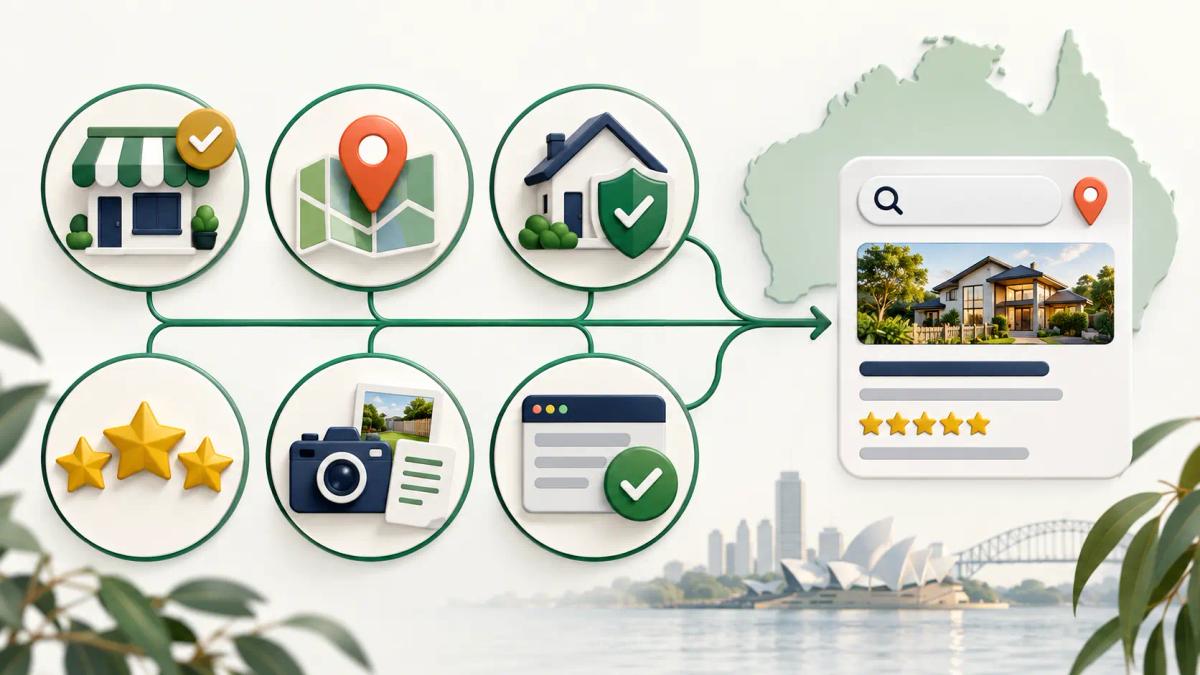
Think of the system as five connected parts:
- Accurate business information that represents the real operating model.
- Priority service pages that match customer intent.
- Honest service-area information that sets clear expectations.
- Original trust signals, including reviews and approved work evidence.
- A technically sound website that search engines and customers can access easily.
That connected view is central to AIECOMSolutions’ pest control industry approach, which brings website content, local visibility, lead capture and operational follow-up into one practical growth system.
Local SEO checklist for pest control companies
Use this checklist to identify the next meaningful improvement. Do not try to do every item in one week; start with the gaps that most affect customers and current lead quality.
- Verify the Business Profile and confirm the business name, category, contact details, website link and hours are accurate.
- Confirm that the profile and website describe only the services and service areas you genuinely offer.
- Review each priority service page on a mobile phone. The service, suitability, proof and contact action should be clear.
- Check that the main Service Areas page answers where you work without claiming locations that are not practical.
- Set a consistent, respectful process for requesting and responding to customer reviews.
- Add original business, team or completed-work images where they help a customer understand what to expect.
- Check that the website is indexable, mobile-friendly, fast enough to use and free from accidental duplicate pages.
- Ensure each article and service page has a descriptive title, unique meta description, canonical URL, internal links and accurate structured data.
- Track which searches and pages produce calls, forms and booked work—not only which pages receive visits.
Keep technical foundations simple and reliable
Technical SEO does not need to be mysterious, but it does need to be maintained. Search engines should be able to crawl important pages, see the core service content in text and understand which URL is canonical. Visitors should be able to use the site comfortably on a phone, where many local pest-control searches begin.
Check that each live page has one clear canonical URL and is not accidentally blocked from indexing. Avoid publishing duplicate pages created by filters, internal searches or CMS previews. Use descriptive page titles and meta descriptions to summarise the page accurately. Add LocalBusiness, Organization, Service or BlogPosting structured data only when it matches the visible page and your actual business information.
Do not treat schema as a shortcut to rankings, and do not add special markup just because a tool calls it “AI-ready.” Good technical implementation makes genuine information easier to access; it does not replace useful content and customer proof.
Measure the searches that turn into useful work
Local SEO should be reviewed as a business activity, not a vanity report. Ranking screenshots are useful context, but the important outcome is whether the right customers can find, contact and book your business.
Review a small set of measures each month:
- Business Profile calls, website visits and other available interaction data.
- Search Console impressions and clicks for priority service and location-related queries.
- Organic enquiries by service type, service area and customer type.
- Time to first human response and the rate at which leads become inspections, quotes or booked work.
- Reviews received, customer feedback themes and recurring pre-booking questions.
- Which pages bring relevant enquiries versus price-only, out-of-area or unsuitable requests.
Combine marketing data with the information your office or technicians already record. If a service page produces plenty of traffic but little suitable work, review its message, location expectations and enquiry flow. If one region produces strong bookings, understand why before expanding further. The goal is not to be visible everywhere; it is to be easy to choose where your business can genuinely deliver.
Make the next local improvement count
Start with the foundation: an accurate Business Profile, clear priority service pages, truthful service-area information and a simple review process. Then improve the gaps you can see in customer feedback, search data and lead quality. That creates a local presence that is more durable than a short-term ranking tactic.
For a practical review of your pest-control website, service-area content and local lead flow, talk to AIECOMSolutions.
NEXT STEP
Ready to Work With a Team That Actually Delivers?
Book a free strategy call. No pitch. Just honest advice.